Most first-time flyers pack for the trip they imagine, not the trip they booked. The result is a carry-on that fails the sizer at the gate, a liquids bag that gets pulled at security, or a checked-bag fee that could have been avoided. The fix is not a longer packing list — it is understanding the five or six rules that decide whether your bag boards with you.
Here are the questions first-time flyers ask most often, answered in the order they come up.
What counts as a carry-on, and what counts as a personal item?
Airlines almost always allow two items per passenger: one carry-on bag that goes in the overhead bin, and one personal item that slides under the seat in front of you. The distinction matters because the personal item is the bag you keep with you at all times, and it is where you should keep anything you cannot afford to lose access to.
Typical limits:
- Carry-on: roughly 22 x 14 x 9 inches (55 x 35 x 20 cm) on most US carriers, and 55 x 40 x 20 cm on many international carriers.
- Personal item: roughly 18 x 14 x 8 inches (45 x 35 x 20 cm), though this varies more than the carry-on limit does.
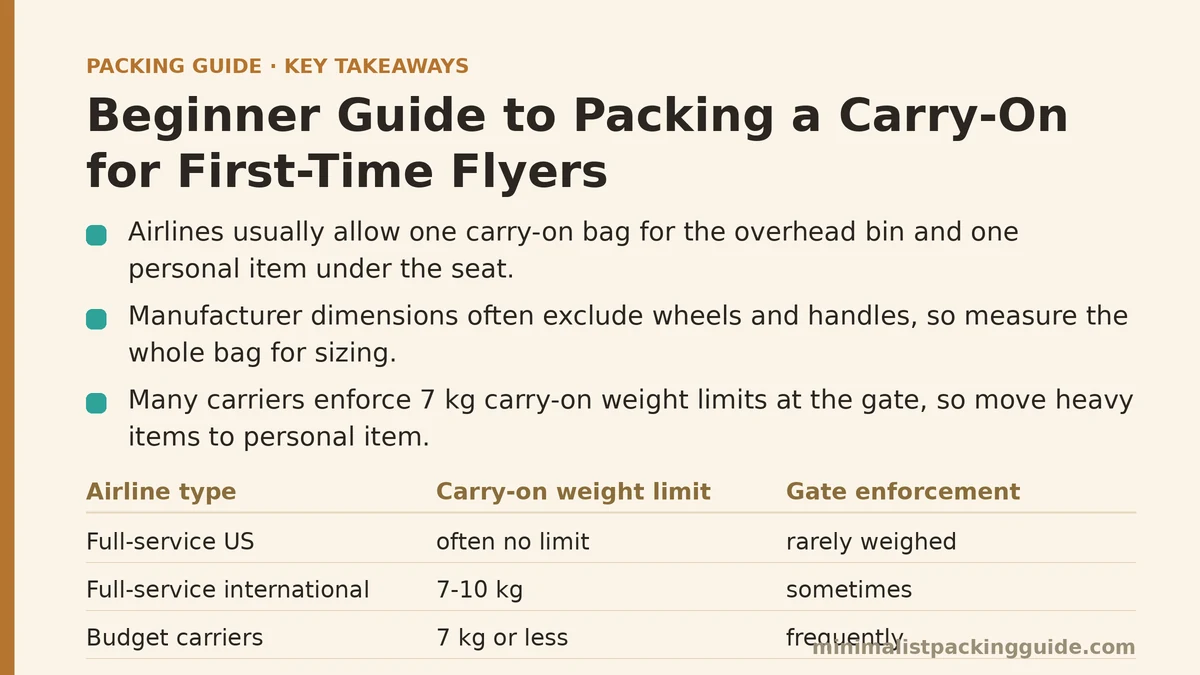
Two things trip people up here. First, manufacturer dimensions usually exclude wheels and handles, so a bag labeled “22-inch carry-on” is often 23 or 24 inches measured overall. Second, budget and low-cost carriers frequently set smaller limits than full-service airlines, and they enforce them more aggressively.
If your bag has wheels and a handle: measure the whole thing, not just the body.
How much can a carry-on weigh?
Weight limits are the rule first-time flyers miss most often. Many assume that if the bag fits the sizer, it passes. That is not true on carriers that weigh at the gate.
| Airline type | Typical carry-on weight limit | Enforced at the gate? |
|---|---|---|
| Full-service US carriers | Often no published weight limit for carry-ons | Rarely weighed |
| Full-service international carriers | 7–10 kg (15–22 lb) | Sometimes |
| Budget carriers | 7 kg (15 lb) or less | Frequently |
| Some Asian and Middle East carriers | 7 kg (15 lb) | Frequently |
A fully packed one-bag setup commonly weighs 8 to 11 kg — over the limit on any 7 kg carrier. The way to fix this is to move dense items (shoes, chargers, toiletry pouches, electronics) into your personal item or into your jacket pockets. That alone can drop a 9 kg bag to 7 kg in about a minute.
What are the liquid rules, and what counts as a liquid?
Most security regimes limit liquids to containers of 100 ml (3.4 oz) or less, packed into a single clear bag of roughly 1 quart (1 liter) capacity, one bag per passenger. Some airports have moved to newer scanners that lift this rule, but you cannot count on your departure airport having them.
The categories that count as liquids surprise people:
- Toothpaste, lotion, sunscreen, and deodorant sticks
- Lip balm, hand sanitizer, and face mist
- Peanut butter, jam, honey, and yogurt
- Aerosols, including shaving cream and dry shampoo
- Any gel, paste, cream, or spread
Containers are measured by their printed capacity, not by how much is inside. A 200 ml bottle that is half empty is still a 200 ml container and will be pulled at security. Decant what you need into travel-size bottles, or buy toiletries at your destination.
How far ahead should I pack, and what should I do first?
Start at least two days before departure, and do the airline-rule homework before you touch a single item. The order that saves the most trouble:
- Look up your specific airline’s carry-on dimensions, weight limit, and item count on the airline’s own site. Write the numbers down.
- Measure your bag with a tape measure, including wheels and handles.
- Weigh your bag once packed, using a luggage scale.
- Pack your personal item first, not last — that is your in-flight kit.
- Pack the carry-on second, working from the heaviest items at the bottom.
Packing the personal item first forces you to decide what you cannot lose access to, and that decision shapes everything else.
What should go in the personal item versus the carry-on?
| Item | Personal item | Carry-on | Why |
|---|---|---|---|
| Passport, ID, boarding pass | Yes | No | You need it at the gate; never stow it |
| Medication | Yes | No | In-flight access, and irreplaceable if the bag is gate-checked |
| Laptop and tablet | Yes | No | High value, fragile, and needed for security screening |
| Power bank / spare batteries | Yes | Only in some cases | Spare lithium batteries are banned from checked baggage |
| Chargers and cables | Yes | Either | Dense, small, useful to keep on hand |
| Headphones, eye mask, neck pillow | Yes | No | In-flight essentials |
| Change of clothes (1 day) | No | Yes | If the bag is delayed, you still have one outfit |
| Toiletries over 100 ml | No | Checked only | Not permitted through security in a carry-on |
| Shoes, bulky clothing | No | Yes | Too heavy for the personal item in most cases |
The pattern: things you need at the gate, in flight, or cannot replace go in the personal item. Things that are bulky but replaceable go in the carry-on.
What packing mistakes get first-time flyers stopped at security or the gate?
Five mistakes cover the large majority of cases:
1. Packing to the absolute limit of the sizer. A bag that only fits when half-empty will fail when full. Leave roughly 10–15 percent of the bag’s volume empty so it can compress.
2. Overfilling the liquids bag. A 1-quart bag stuffed past its closure gets pulled aside. Leave slack so the zip closes without force.
3. Carrying a third bag. A shopping bag, a camera case, or a tote over the shoulder counts as a third item and is the single most visible trigger at the boarding door.
4. Attaching items to the outside of the bag. A jacket tied on, a water bottle in a side pocket, or a tripod strapped to the frame makes the bag read as larger and heavier than it is.
5. Boarding last. On a full flight, gate agents start gate-checking from the back of the boarding queue regardless of bag size, because there is nowhere left in the overhead bin.
What if my bag fails the sizer or the scale at the airport?
You have three fixes, in order of what works fastest:
- Move dense items to your personal item or your pockets. Shoes, chargers, electronics, and toiletry pouches come out first. This typically removes 1 to 2 kg and lets the bag’s sides compress.
- Wear your bulkiest layer. A jacket, sweater, or pair of jeans worn onto the plane does not count against your allowance on any airline.
- Repack flat instead of round. A bag that bulges in the middle fails the sizer, but the same contents redistributed into a flatter profile often pass. Structured items go against the back panel; soft items go near the opening.
If none of those work, know the gate fee before you decide. Gate-check fees at budget carriers commonly run $50 to $75 per bag — higher than the price of checking a bag online in advance.
How do I pack the bag so it fits and survives the flight?
A simple sequence that works for most trips:
- Lay flat items against the back panel. A folded jacket or a pair of trousers goes here, flat against the frame.
- Roll soft clothing into the mid-layer. T-shirts, underwear, and light knits roll tight and fill gaps.
- Place dense items at the bottom, near the wheels. Shoes stuffed with socks, toiletry bags, and electronics if they fit.
- Fill gaps with small items. Socks, chargers, and rolled belts go in the leftover space around the edges.
- Keep the top layer accessible. Anything you want during the flight (a book, a light layer) goes on top.
A note on shoes: they are dense and shape-stable, so they anchor a corner well. Stuff them with socks to hold their shape, and place them sole-out along one edge.
What should I do today, before my flight?
Three steps you can take right now:
- Write down your airline’s exact carry-on dimensions, weight limit, and item count. Use the airline’s own site, not a search result summary.
- Measure and weigh your packed bag using a tape measure and a luggage scale. If either number exceeds the airline’s limit, remove dense items until both are inside.
- Pack your personal item first, and confirm it slides under a seat. That way, a gate check becomes an inconvenience rather than a problem.
Once those three things are done, the rest of packing is just fitting clothes into the space that is left — and that part is far easier than getting the rules right.
Related guides: Step-by-Step Guide to Packing Your First Carry-On-Only Trip, Minimalist Packing Mistakes Carry-On Only Travelers Make, and Carry-On Packing Mistakes That Trigger Airline Gate Checks.