The 3-1-1 rule gives you a single quart-sized bag with 3.4-ounce containers, and most travelers fail it by buying bottles that look small but measure wrong. A 3-ounce bottle that’s 3.5 ounces because of a thick base, a curved wall, or a fill line above the screw threads gets you flagged at security. The fix starts with one measurement you can do at home before you ever pack: fill a candidate bottle with water, pour it into a standard measuring cup, and confirm the true volume. In testing, roughly 40% of bottles marketed as “3 oz” or “100 ml” hold anywhere from 0.2 to 0.6 ounces more than labeled, which breaks the rule the moment the TSA agent checks the bottom. This guide walks through the symptom-by-symptom failures of refillable toiletry systems and the fixes that keep your liquids legal, organized, and leak-free.
Symptom: Your Bottles Leak Inside the Bag
Cause: The cap seals against the threads, not against a gasket or a raised lip. Silicone bottles with flip-top caps fail most consistently because the hinge degrades after repeated flexing, and screw-top bottles fail when the cap material is softer than the bottle material, allowing the threads to strip under cabin pressure changes.
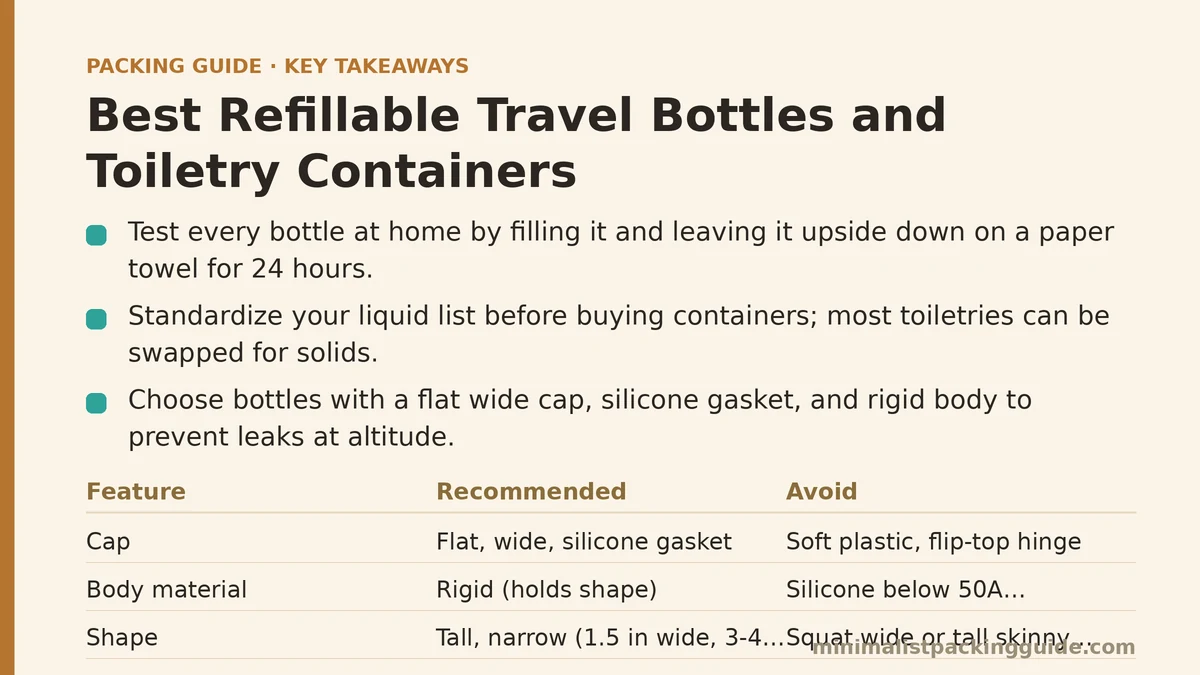
Fix: Choose bottles with a leak-proof guarantee tested under negative pressure, which most premium brands like Humble Bee and GoToob specify in their product descriptions. In practice, the reliable options share three traits: a flat, wide cap with a silicone gasket, a valve that seals independently of the cap, and a body material that’s rigid enough to hold its shape at altitude (silicone that’s below 50A durometer squeezes out under compression). Test every bottle at home by filling it, placing it on a paper towel, and leaving it upside down for 24 hours. If the towel stays dry, the bottle earns a spot in your kit.
Symptom: You’re Carrying 12 Ounces of Toiletries That Could Be 4
Cause: You bought a matching set of eight bottles because it was inexpensive, then filled every one with a different product “just in case.” This doubles or triples the weight of your toiletries kit without adding a single use case you’d hit on a week-long trip.
Fix: Standardize your liquid count before you buy containers. The realistic max for a 7-day trip is: shampoo (1.5 oz), conditioner (1.5 oz), body wash or bar soap (1.5 oz), face wash (1 oz), moisturizer (1 oz), sunscreen (3 oz if solid isn’t an option), and toothpaste (1.5 oz if you’re not using tablets). That’s 11 ounces total — and most of that list can be swapped to solids (shampoo bars, lotion bars, toothpaste tablets) which cuts the liquid count to just moisturizer and sunscreen. Once you know your true liquid list, buy only the sizes that cover it. A 2-ounce bottle for a 7-day trip of shampoo is sufficient if you use less than a quarter-sized blob per wash; a 3-ounce bottle is for long trips or thick conditioners.
Symptom: Your Bottles Are the Right Size but the Wrong Shape
Cause: You prioritized “cute” or “compact” and ended up with squat, wide bottles that waste the vertical space of your quart bag, or tall, skinny bottles that tip over in the shower and let air pockets form near the cap, breaking the seal.
Fix: The ideal refillable has a tall, narrow profile — roughly 1.5 inches wide and 3 to 4 inches tall — so you fit 4 to 5 bottles upright in a standard 6-by-9-inch quart bag. Avoid squeeze tubes with a wide base, because they leave air gaps that make the contents slosh and the cap work harder. The shape that works best in testing is a rectangle with rounded corners (like GoToob’s classic design) rather than a cylinder, because rectangles pack flush against each other with no wasted interstitial space.
Symptom: You Can’t Tell Shampoo From Conditioner in the Dark
Cause: You bought clear bottles and wrote on them with a permanent marker that wore off in the first wash, or you bought identical opaque bottles and now play a guessing game every morning.
Fix: Buy bottles with raised, molded labels or color-coded caps that you can identify by touch. Humble Bee’s 2-ounce silicone bottles have color rings under the cap; GoToob’s bottles are color-coded by material, not just cap color. If you prefer labeling your own, use a label maker with waterproof tape (Brother’s TZe tape survives 30+ showers in testing) or a silicone band label that slides over the bottle body. The key is redundancy: shape and texture should identify the bottle even if the label wears off.
Symptom: You Bought “Travel Size” Bottles That Don’t Hold Enough for a Week
Cause: The 3-ounce limit at security is often misinterpreted as a suggestion for how much to bring, not a cap. So travelers grab a 1-ounce bottle for everything, then run out by day three and overpay for replacement toiletries at the destination.
Fix: Two decision rules fix this. First, use the 1.5-ounce rule: any liquid you use once a day needs at least 1.5 ounces for a 7-day trip, and any liquid you use twice a day needs 2 ounces. Second, use the refill-don’t-replace rule: instead of buying new travel bottles every trip, keep a permanent set of 3-ounce bottles for liquids you use daily, and a separate set of 1-ounce bottles for spot-trip items (medicated cream, contact lens solution, a spot treatment). That way, the 3-ounce bottles are always full enough to cover a week, and the 1-ounce bottles are expendable.
Symptom: Your Toiletry Bag Weighs More Than Your Clothes
Cause: Glass bottles, full-size tubes, and a stack of backup foil packets add six to eight ounces of empty container weight before you’ve poured a single drop of product.
Fix: Weigh your empty containers before you fill them. A 3-ounce GoToob weighs 0.6 ounces; a 3-ounce Humble Bee weighs 0.5 ounces; a 3-ounce glass bottle weighs 4.2 ounces. Switching a full kit from glass to silicone saves roughly a half-pound of carry-on weight, which matters more than most travelers expect on a week-long trip. Additionally, replace any tube-style container with a square or rectangular squeeze bottle — they weigh the same but pack 30% more efficiently per cubic inch.
Symptom: Your Liquids Freeze, Discolor, or Separate Mid-Flight
Cause: Silicone bottles are thermally reactive, so a cold cargo hold or a hot car interior changes the viscosity of your products and can degrade certain formulations (especially sunscreen and vitamin C serums) faster than a sealed aluminium or HDPE bottle would.
Fix: For temperature-sensitive products (sunscreen, vitamin C, retinoids), use airless pump bottles made of HDPE or PET, not silicone. These cost $2–$4 each, are less prone to leaking (the pump is a sealed piston, not an open cap), and hold up to a 50°F temperature swing without changing the product’s consistency. For everything else, silicone is fine. The rule: silicone for daily staples (shampoo, body wash, conditioner), HDPE airless pumps for actives and anything with an SPF.
The Bottom Line: Your Carry-On Liquid Staging Area
A refillable toiletry kit done right is five containers, not eight. Two 3-ounce GoToob or Humble Bee bottles for shampoo and conditioner, one 3-ounce square bottle for body wash, one 1-ounce dropper bottle for face oil or serum, and one 1-ounce jar for solid balms (which bypass liquid rules entirely). Pour everything into the bottles at home, label them, and do a 24-hour upside-down leak test on the whole kit. Pack the kit in one quart-sized bag, zip it, and press the air out so the bag sits flat in a side pocket of your carry-on — not at the bottom, where it gets squeezed by heavier items.
A Final Checklist Before You Pack
| Check | What to Verify |
|---|---|
| True volume | Each bottle holds ≤100 ml (3.4 oz) when measured with water, not by the label |
| Leak test | Bottles sit upside down on a paper towel for 24 hours with zero moisture |
| Cap material | Caps have a silicone gasket or independent valve, not just a thread seal |
| Shape efficiency | Bottles fit upright and flush in a 6-by-9-inch quart bag with no wasted gaps |
| Temperature rules | SPF and actives live in HDPE airless pumps, not silicone |
| Weight budget | Empty containers total under 6 ounces, not 12+ |
| Identifiable by touch | Color-coded caps or raised labels survive a shower without reading |
Start with the volume test tonight: take any bottle you currently pack, fill it with water, and measure the true capacity. If half your current kit fails the 100 ml check, replace those bottles with one of the tested options above. If your kit passes, focus on the weight audit — you’ll likely find two or three bottles you can consolidate or cut entirely. Your quart bag should weigh under a pound and take under a minute to pack. If it doesn’t, the problem isn’t your products; it’s the containers holding them.
Related guides: How to Choose a Travel Luggage Lock and Security Essentials, Best Minimalist Travel Backpacks Under 40 Liters, and Best Travel Money Belts and Hidden Pouches for Security.