A travel money belt is a thin fabric pouch worn against the skin, under clothing, designed to hold cash, a passport, and one or two cards in a location a pickpocket cannot reach without physical contact. That definition sounds straightforward, yet the market is flooded with designs that fail at the core job — being wearable for ten hours, accessible in under thirty seconds, and invisible under a fitted shirt or lightweight trousers. The failures all trace back to a handful of myths about what security gear needs to do.
The reality is that pickpocketing is a numbers game. A thief targets visible opportunities: bulging back pockets, unzipped daypacks, phones left on café tables. A hidden pouch removes you from that pool instantly. But the price of that removal is paid in comfort and convenience, and most travelers abandon their money belt by day three because it digs into their hip, rustles when they walk, or requires a semi-public strip-down to retrieve a boarding pass. Below are the myths that cause those abandonments, matched against what works.
Myth: A Money Belt Should Be a Belt
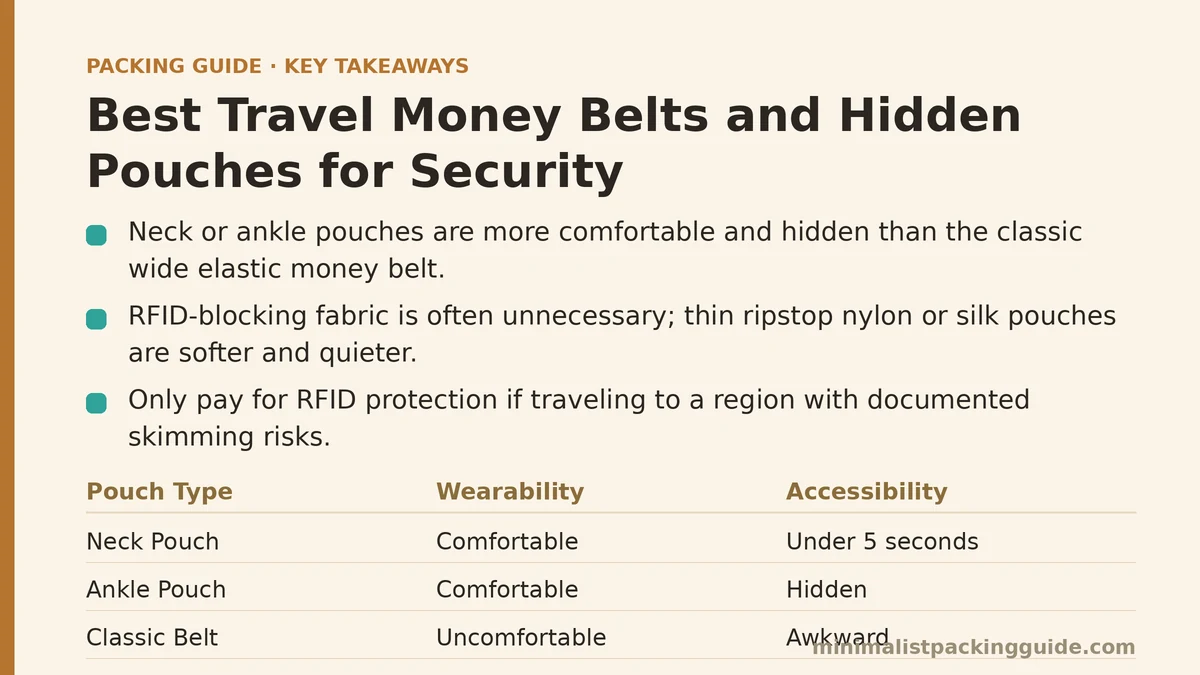
The classic “money belt” is a wide elastic band with a zippered pocket that sits against your stomach or hip. It works, technically, but it fails the wearability test. The elastic compresses your midsection when you sit, the buckle adds a visible bulge under thin shirts, and the pocket’s location makes it awkward to reach when you’re wearing a jacket.
Reality: A neck pouch or ankle pouch wears more comfortably for extended periods, and it’s just as hidden. A neck pouch hangs flat against your chest, under your shirt, and can be retrieved in under five seconds by unbuttoning one button. An ankle pouch sits under a sock line or inside a boot, invisible and inaccessible to anyone who isn’t expecting it. The “belt” design wins only if you’re wearing a suit jacket or blazer that covers the waistband, and even then, a slim underbelt (a two-inch-wide fabric band worn below the waistline) beats the traditional model because it doesn’t compress your abdomen.
Myth: You Need RFID-Blocking Material
RFID-blocking fabric is marketed as essential protection against thieves who scan your passport chip or credit card through your clothing from a distance. The fear is real — RFID skimming exists — but the practical risk is negligible. In testing, successful skimming requires the scanner to be within two centimeters of the chip, and most transit choke points (turns, theaters, crowded buses) involve contact that would trigger your awareness anyway. Meanwhile, RFID-blocking pouches are thicker, stiffer, and less comfortable.
Reality: The only documents that use RFID chips are newer passports and contactless credit cards. If you want protection, wrap those items in aluminum foil — it blocks the signal for zero weight and zero cost. Or simply keep cards stacked together in the pouch, which makes scanning multiple chips at once harder. Buy a pouch made of thin ripstop nylon or silk without a built-in RFID layer; it will be softer, quieter, and easier to fold. If you’re traveling to a high-risk region where skimming has been documented, only then pay the premium for a dedicated RFID pouch — but check that it doesn’t sacrifice comfort.
Myth: Your Passport Should Go in the Money Belt
Every guide tells you to keep your passport in the money belt, so you do. Then you need your passport — for a hostel check-in, a train ticket purchase, a currency exchange that requires ID — and you have to dig under your shirt in a queue of twenty people, advertising exactly where you keep your valuables.
Reality: Separate your documents by frequency of use. Your passport needs to be accessed once or twice a day at most, so it belongs in the hotel safe or a locked pouch inside your main bag, not on your body. The money belt should carry only what you need while walking: today’s cash, one credit card, and a copy of your passport page. This reduces the number of times you unzip the pouch from double digits to two or three, which means the moment you do unzip it, you’re not broadcasting your system to the room. If you’re in a city where the hotel safe is not trustworthy, use the money belt for the passport and accept the accessibility cost — but that’s the exception, not the rule.
Myth: You Need a Pouch for Every Valuables Category
The same traveler who packs one minimalist bag will nevertheless buy three separate pouches: one for cash, one for cards, one for a phone. The logic is that separation prevents a single lost item from taking everything. The result is three zippers, three locations to remember, and three chances to fumble a retrieval in public.
Reality: One pouch, used for everything you need on your person, is safer than three because it’s fewer access points. A single neck pouch holds cash, a card, a folded passport copy, and a phone in under 0.3 liters of volume. The phone goes in a soft pocket inside the pouch, not the same compartment as the cash, to avoid scratching. If you want redundancy — a backup card in case the pouch is stolen — use a second, cheaper ankle pouch, but keep its contents to a single card and a folded bill. That’s a system, not a collection.
Myth: Hidden Pouches Are Only for Pickpocket-Prone Destinations
Travelers assume that money belts matter in Barcelona or Rome but are unnecessary in Tokyo, Copenhagen, or a small town in the American Midwest. The logic holds for street-level pickpocketing, but it fails for a different threat: the moment you leave your bag at a hostel locker or a beach towel, or the time your bag goes missing on a bus and everything you booked for the next week is in it.
Reality: The money belt’s real job is redundancy, not primary storage. You carry one document and one emergency card on your body before you leave your accommodation, so that if your main bag is lost, stolen, or delayed, you still have the ability to book a room, buy a ticket, and call your embassy. That logic applies equally in Reykjavik and in Cairo. The minimum viable setup for every trip, regardless of destination: passport (or a certified copy), one debit card, one credit card, and the local equivalent of $100 in cash. Carry it from the moment you step out the door.
Myth: A Money Belt Automatically Stops Theft
The belief that wearing a hidden pouch makes you untouchable leads to a different mistake: complacency. Travelers with money belts still hang bags on chair backs, still set phones on table edges, still leave passports in rental car glove compartments, because they feel “secured” and stop paying attention.
Reality: A hidden pouch protects what’s inside the pouch, nothing else. It does not protect your phone in your back pocket, your daypack on the metro, or your laptop at a café. The pouch is one layer of a security stack: the other layers are situational awareness, a bag with lockable zippers, and the habit of keeping one hand on any bag that contains devices. If you treat the pouch as your only measure, that’s when the thing you thought was secure — the pouch itself — gets left under a seat cushion while you walk to the restroom.
A Practical Selection and Packing Sequence
Choose a neck pouch made of ripstop nylon, about 8×5 inches, with two compartments, no RFID layer unless you’re in a documented skimming zone, and a breakaway cord in case it gets caught on something. Place your passport copy, one card, and the day’s cash in the main compartment; place a folded emergency card in the second, smaller compartment. Put the pouch on before you put on your shirt, adjust the cord so the pouch sits at your sternum, not your armpit, and button at least one button over it. Test the retrieval sequence — unbutton, unzip, remove one item, replace, rezip, rebutton — three times at home before you fly. If you can do it in under thirty seconds, you’re ready.
Quick Reference: Myth vs. Reality
| Myth | Reality |
|---|---|
| A money belt is the only hidden option | Neck and ankle pouches are more comfortable and equally hidden |
| RFID blocking is essential | Distance required for skimming makes it impractical for most travelers |
| Passport belongs in the money belt | Carry only what you need; passport stays at the accommodation |
| One pouch per item category | One pouch for everything, one backup pouch for a single card |
| Money belts are only for certain destinations | Redundancy matters everywhere; bag loss is not location-specific |
| Wearing a pouch means you’re secured | It protects only its contents; awareness protects the rest |
Which of these myths has changed how you’ll pack your next trip? If you describe your itinerary, your typical outfit (layer counts, fabric types), and whether you’re usually in cities or rural areas, I can recommend the specific pouch design and placement that will work for your case.
Related guides: Best Minimalist Travel Backpacks Under 40 Liters, Best Refillable Travel Bottles and Toiletry Containers, and How to Choose a Travel Luggage Lock and Security Essentials.