A carry-on packing system for a finance professional is a set of decisions that reduce a week-long business trip to a single bag under 22 pounds, with every item serving at least two functions and zero items packed “just in case.” The metric that matters is not volume but utilization — each garment must work across client meetings, airport security, and dinner without demanding a backup.
Finance travel has a specific failure mode that casual travel doesn’t. You are not packing for leisure; you are packing for credibility. A wrinkled suit, a scuffed shoe, or a shirt that’s clearly been worn twice in a row reads as a lack of control, which is the one thing your clients are paying you to project. That pressure drives overpacking — full garment bags, duplicate outfits, and a checked bag that costs you an hour at baggage claim on both ends of the trip. Below are the myths that cause the bloat, matched against what works under the actual constraints of a business trip.
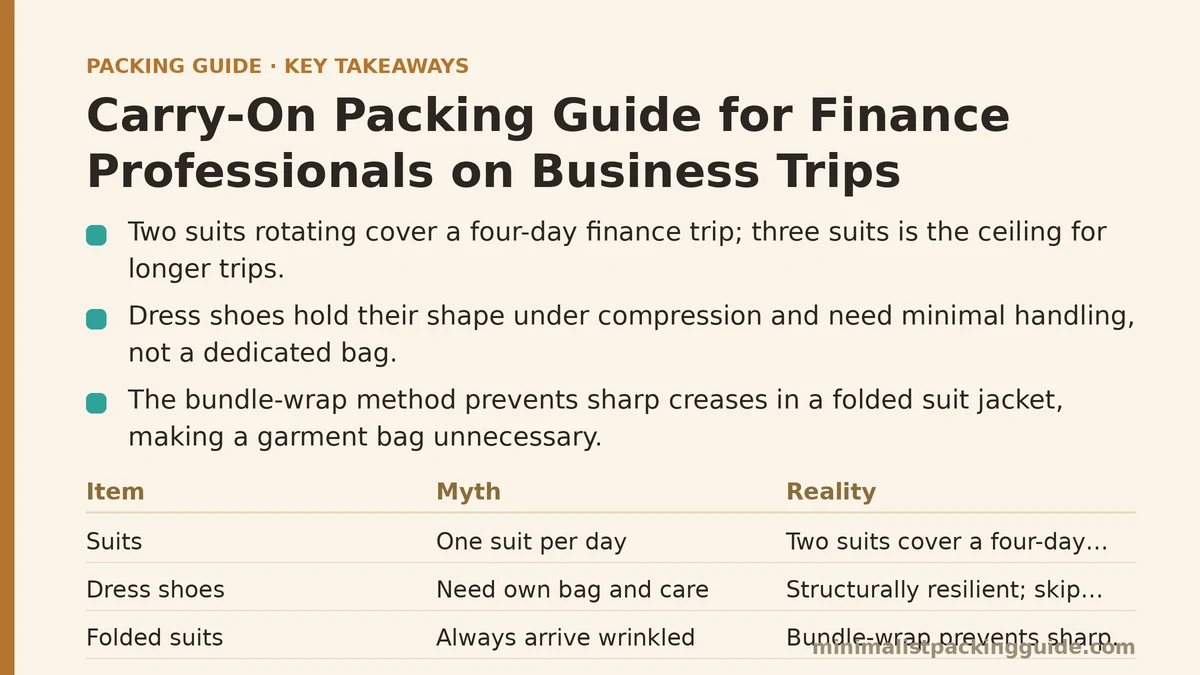
Myth: You Need a Suit for Every Day You’re On Site
The default packing list for a four-day finance trip looks like this: four suits, four shirts, four ties, four pairs of socks, four of everything. The reasoning is that each day is a fresh client-facing event, and repeating an outfit signals that you’re not keeping up. In practice, nobody remembers what you wore yesterday except you.
Reality: Two suits cover a four-day trip. Wear one on travel day, one on the first full day, then rotate. If the itinerary includes a formal dinner, the suit you wore on day one works for that too — swap the shirt and tie and it’s a different look. For a trip longer than four days, three suits is the ceiling. The math is simple: a suit is worn for six to ten hours a day, but it needs twenty-four hours to rest and shed wrinkles. Two suits rotating gives you that rest window. Three suits is a luxury that fits if your bag allows it, but two is the working number.
Myth: Dress Shoes Need Their Own Bag and Their Own Care Routine
Dress shoes are the most mistreated items in a finance traveler’s bag. People wrap them in shoe bags, stuff them with tissue, dedicate an entire packing cube to them, and treat them as delicate objects that need to be quarantined from the rest of the contents.
Reality: Dress shoes are the most structurally resilient item you’re packing. A pair of oxfords or loafers holds its shape under compression better than any shirt or suit. The correct handling is minimal: stuff each shoe with a rolled belt or a pair of socks to preserve the toe box, then place them sole-out along one edge of the bag, where they act as an anchor that protects the softer items next to them. Skip the shoe bag — it adds a layer of fabric that does nothing but take space. The shoes will touch other items; that’s fine. They won’t crush them, and they won’t be crushed themselves.
Myth: Folded Suits Always Arrive Looked Like You Slept In Them
The most persistent fear in business travel is that a folded suit will arrive with a crease down the center of the back that no amount of hanging can remove. That fear is the single biggest driver of garment bag usage, and garment bags are the single biggest waste of space in the carry-on equation.
Reality: The bundle-wrap method — folding the suit jacket inside-out, with the shoulders rounded rather than squared, and wrapping it around a soft core of rolled garments — prevents the sharp diagonal creases that ruin folded suits. The suit will have some surface wrinkling after a flight. That is normal. It will hang out in your hotel closet for forty-five minutes and be indistinguishable from one that was never folded. The key is the roll-and-bundle technique, not the bag. A garment bag either becomes a second carry-on or takes up the same space as a folded suit while doing less protection work. It’s a solution to a problem that the bundle method already solves.
Myth: Your Laptop Bag Is a Separate Category From Your Clothes Bag
Finance professionals typically travel with a roller bag for clothes and a separate briefcase or backpack for the laptop, documents, and chargers. That’s two bags to manage through security, two bags to wheel through the terminal, and two bags to keep track of in a cab. It also means the roller bag is often under-packed because the laptop bag is holding a third of your actual load.
Reality: A single carry-on with a dedicated laptop compartment — or a three-quarter zip duffel with a padded sleeve — eliminates the second bag entirely. Your laptop, chargers, and documents slide into the same bag as your clothes, and you walk through the airport with one hand free. The trade-off is that you lose some packing volume to the laptop compartment, typically 15-20% of the bag’s capacity. That loss is intentional; it forces you to edit your packing list down to what matters. If your firm requires a separate briefcase for client meetings, pack it inside the carry-on empty and pull it out at the hotel. It weighs less than a pound and folds flat.
Myth: You Need a Full-Size Toiletry Kit With Everything You Use At Home
The standard finance traveler’s toiletry kit resembles a pharmacy shelf: full-size shampoo, conditioner, body wash, three different hair products, a razor kit, and a backup of everything because “you never know.” That kit weighs four to six pounds and eats a quarter of your bag’s volume.
Reality: Solid toiletries — a shampoo bar, a conditioner bar, a bar of facial soap — cut the weight by two-thirds and sidestep the TSA liquid limit entirely. For the items that must stay liquid — deodorant, toothpaste, contact lens solution — 3-ounce travel bottles are enough for a five-day trip. You will use less at a hotel than you think, both because you’re less likely to go through a full routine and because the hotel supplies half of what you’d normally bring. The real rule: if a hotel provides it, you don’t bring it. Most mid-tier business hotels provide soap, shampoo, a hairdryer, and an iron. What you add is the items that are personal to you — and nothing else.
Myth: The More You Pack, The More Prepared You Are
There’s a comforting correlation that many travelers believe: more items equals more contingency coverage. A fire drill, a spilled coffee, an unexpected dinner with a client you weren’t told about — all of these feel like they require a backup outfit. So you pack a spare shirt, a spare set of socks, a spare tie, and the bag swells.
Reality: The actual failure rate of a well-chosen capsule wardrobe is low. A six-piece rotation — two suits, three shirts, one spare pair of trousers — covers four consecutive days with no repeats, and it covers spills and stains with a single emergency kit: a stain-removal pen, a mini lint roller, and a sewing kit that weighs less than two ounces combined. Those three items handle 95% of the wardrobe emergencies that occur on a business trip. The 5% that they can’t handle — a torn suit, a lost shirt — is not something a backup outfit reliably solves anyway, because you won’t have the right backup for the specific failure. Better to accept the small risk and pocket the space.
The Finance Professional’s Carry-On Packing Sequence
Start with the two suits, folded using the bundle-wrap method, placed at the core of the bag. They’re the largest items, so they set the shape of everything else. Roll the three shirts and tuck them into the gaps around the suits. Lay the dress shoes sole-out along one edge, stuffed with a rolled belt and socks. Place the laptop flat against the back panel, in its dedicated sleeve. Slide the toiletry pouch into the remaining corner, and the emergency kit into the front pocket. Zip it up. If it doesn’t close smoothly, that’s a sign you’re overpacking — remove one item and try again. There is no such thing as a bag that’s too tight to close.
Quick Reference: Business Travel Myth vs. Reality
| Myth | Reality |
|---|---|
| A suit for every day on site | Two suits rotating with a 24-hour rest window covers four days |
| Dress shoes need separate padded storage | Stuff them with small items and anchor them along the bag’s edge |
| Folded suits arrive unrecoverably wrinkled | Bundle-wrap folding prevents permanent creases; hotel hanging fixes the rest |
| Laptop and clothes require two bags | One carry-on with a laptop sleeve eliminates the second bag |
| Full-size toiletries are necessary | Solid bars plus 3-ounce travel bottles cover a week at a fraction of the weight |
| More items equal more preparedness | A two-ounce emergency kit handles the realistic failure modes |
Which of these myths has driven your business trip packing list in the past? If you’ve got a trip coming up with a specific itinerary — number of days, client meetings, and any formal dinners — describe it and I can help you map out the exact bag contents.
Related guides: One-Bag Packing List for Traveling Sales Reps, One-Bag Packing for Consultants: Client-Site Travel, and A Step-by-Step Guide to Packing Your First Carry-On-Only Trip.