The most common misconception about packing cubes is that they are a storage device. They are not. Packing cubes are a compression and organization tool, and when people treat them like tiny drawers, they lose roughly a third of their carry-on’s usable space. The difference between a well-packed cube and a poorly packed one is not a matter of opinion — it is a measurable gap of 30-40% in bag capacity, and it is the difference between fitting everything in a 40-liter bag and needing a 55-liter bag for the same trip.
Packing cubes solve two specific problems: they compress soft clothing into a denser form, and they partition your bag so you can find things without unpacking everything. Most travelers only get one of those benefits, or neither. Below are the seven most common cube mistakes, ranked by how much capacity they cost you.
7. Using Too Many Cubes
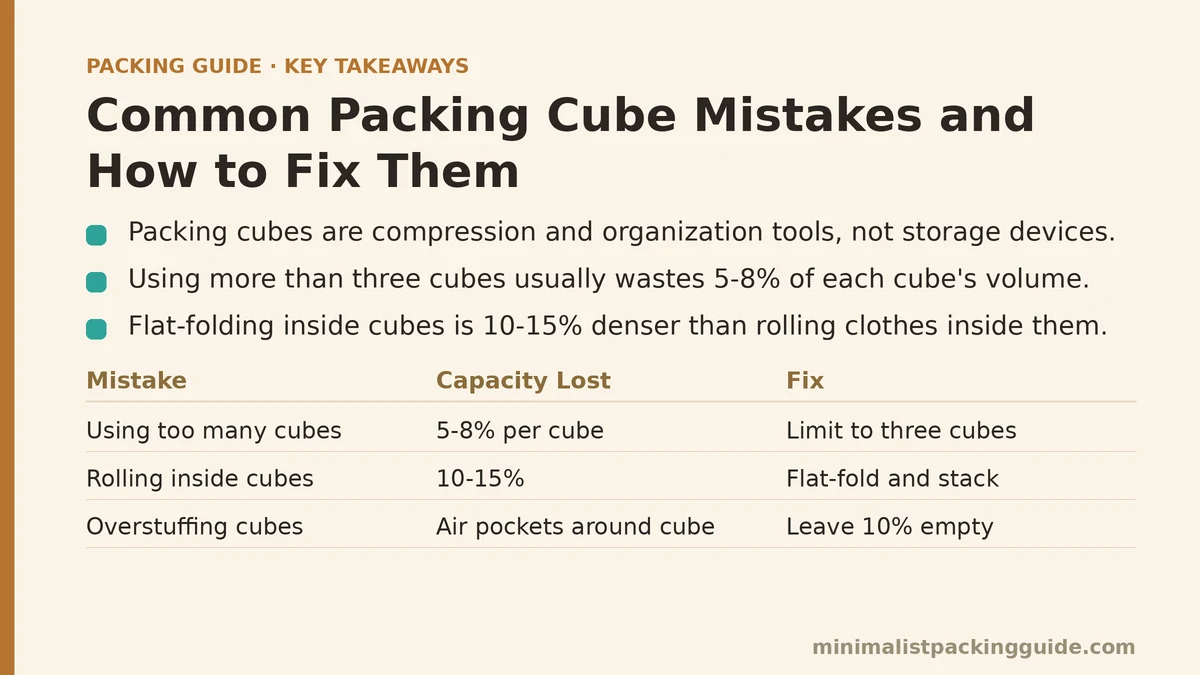
The instinct to buy a set of six or eight cubes and use them all is understandable — you paid for them, and they look neat lined up in your bag. In practice, every cube adds a fabric layer and a zipper line around its contents, which costs you roughly 5-8% of that cube’s volume on its own. Two or three cubes used well beat six cubes used poorly.
The fix: Limit yourself to three cubes maximum — one for bulkier items (sweaters, jackets), one for your daily-wear rotation, one for underwear and socks. Anything beyond that overlaps with another cube’s job or introduces empty space that could be filled with rolled clothing.
6. Rolling Instead of Folding Inside the Cube
Rolling clothes is the standard advice for packing a bag without cubes, and it works well — rolled items are dense and don’t crease badly. Inside a cube, though, rolled items create a problem: they leave cylindrical gaps between them, and those gaps are wasted volume. A cube full of rolled garments is measurably less dense than a cube full of flat-folded items, by about 10-15%.
The fix: Use the flat-fold-and-stack method inside cubes. Fold each garment into a rectangle that matches the cube’s width, stack them flat, and use the cube’s compression zipper to squeeze out the air. The compression zipper is the entire point of a cube — rolling a garment before putting it in a cube makes the compression zipper mostly useless, because the zipper is already working against round shapes that don’t compress evenly. If you must roll, use the cube only for the rolled items’ security, not for compression, and expect to lose that 10-15% of space.
5. Filling the Cube To Its Absolute Capacity
Overstuffing a cube to the point where the zipper barely closes is a common failure. The cube then becomes a rigid, brick-like shape that leaves gaps between itself and the other contents in your bag. A hard, overstuffed cube cannot conform to the curved bottom of a backpack or the angled corners of a roller bag — it forces air pockets around it, and those pockets eat up space that rolled items could fill.
The fix: Leave about 10% of the cube’s volume empty before you close it. A slightly loose cube compresses down when the bag is closed, conforms to its surroundings, and allows irregular gaps to be filled with smaller items. The goal is a cube that is full but still flexible — when you push on it, it yields slightly, rather than feeling like a block of wood.
4. Using Compression Cubes With Non-Compressible Items
Compression cubes — the ones with a second zipper that squeezes the contents — work spectacularly on soft, fluffy items: down jackets, sweaters, fleece, thick cotton. They do almost nothing for dense, incompressible items: jeans, denim jackets, multiple cotton t-shirts stacked flat. The compression zipper squeezes out air, not material, and if there is no air in the items to begin with, you are just rearranging fabric.
The fix: Sort items by compressibility before assigning them to cubes. Soft, air-trapping garments go in the compression cube — a down jacket can shrink by 50% inside one, and wool sweaters by a similar margin. Jeans, canvas, and tightly-woven cotton go in a standard cube or rolled loose in the bag, where they save you nothing by being compressed but also don’t waste a cube’s zipper mechanism on items that won’t change size anyway.
3. Packing a Separate Cube for Underwear and Socks
A dedicated “underwear and socks” cube feels organized, but it is one of the most wasteful things you can pack. Underwear and socks are the smallest, most flexible items in your bag — they fill irregular gaps that larger, bulkier items cannot. Sealing them in a rigid cube traps them in one place and forces them to occupy space that could serve double duty as gap-fillers.
The fix: Abolish the dedicated small cube. Roll each pair of socks and tuck them inside your shoes, as you would without cubes at all. Push underwear into the gaps between larger folded items, or into the corners of the bag where nothing else fits. If you insist on a single pouch for these, choose a flat, non-rigid stuff sack that can squish into whatever space remains — not a structured cube that holds its shape regardless of what is around it.
2. Not Compressing the Cube After Opening It Mid-Trip
The compression zipper is the most valuable feature on a compression cube, and most travelers use it once — when they pack at home. After the first night of a trip, you open the cube to pull out a t-shirt, close it, and fail to re-compress it. Each time you do this, the cube’s contents expand to a looser state, and over a week-long trip, that loose state costs you 15-20% of the bag’s original capacity without you noticing the gradual change.
The fix: Build re-compression into your nightly routine. When you put the cube back in your bag, spend ten seconds working the compression zipper. In practice, this takes longer to explain than to do — the zipper is a single pass around the cube, and the time cost is negligible. On a seven-day trip, re-compressing every night preserves the same density you started with, so you don’t find yourself struggling to close the bag on day five with items you’ve added along the way.
1. Assuming Cubes Provide Rigid Structure to the Bag
The biggest mistake travelers make with packing cubes is treating them as though they make the bag’s interior stiff and stable, then resting the bag’s shape on that assumption. They don’t. A packing cube is a fabric pouch — it holds its shape only as well as the items inside it hold theirs. When you pack a cube full of soft, loosely-packed clothes, the whole bag becomes soft and floppy, and the bag’s internal structure — the frame that keeps a backpack upright or a roller bag’s wheels aligned — ends up taking weight it was never designed to carry.
The fix: Use cubes to distribute density, not to create structure. The heavy, dense items — shoes, toiletries, electronics, a rain shell — belong at the bottom or back of the bag, where they anchor the load. Cubes full of clothing go on top or in front of that anchor layer, where they add volume without weight. A bag packed this way keeps its shape regardless of how soft the cubes are, because the dense layer provides the rigidity that the soft layer cannot.
What to Do Next
If you are packing for a trip this week, run through this checklist before you close your bag:
- Count your cubes. If you have more than three, pull out the extras and redistribute their contents into the remaining three or into the bag itself.
- Test each cube for flexibility. Push on the closed cube — if it feels like a rigid brick, remove one item and try again.
- Assign compressible items to the compression cube and keep dense items out of it.
- Tuck socks and underwear into gaps — they are gap-fillers, not a category.
- Weigh the bag after packing. If it is under the airline limit, stop adding items — the extra space you have now is a sign your cube strategy is working.
The measurable result of these changes: most travelers recover 20-30% of their bag’s volume without removing a single item. That extra space is either a smaller bag on the next trip, or room for the things you would otherwise have left behind — your choice.
Related guides: Why Your Toiletry Bag Keeps Leaking: Common Mistakes and Fixes, Best Packing Cubes for Minimalist Travelers, and Packing Cubes vs. Compression Sacks: Which Saves More Space?.