After reading this, you will be able to pack a full Monday-to-Thursday consulting week — two suits, dress shoes, a laptop, and everything else a client site demands — into a single legal carry-on plus a personal item, without checking a bag and without paying a single gate fee. The rest of this guide answers the questions consultants ask most often when they make that switch, in the order those questions tend to surface.
Why does carry-on-only matter more for consultants than for other travelers?
Three reasons, and they compound.
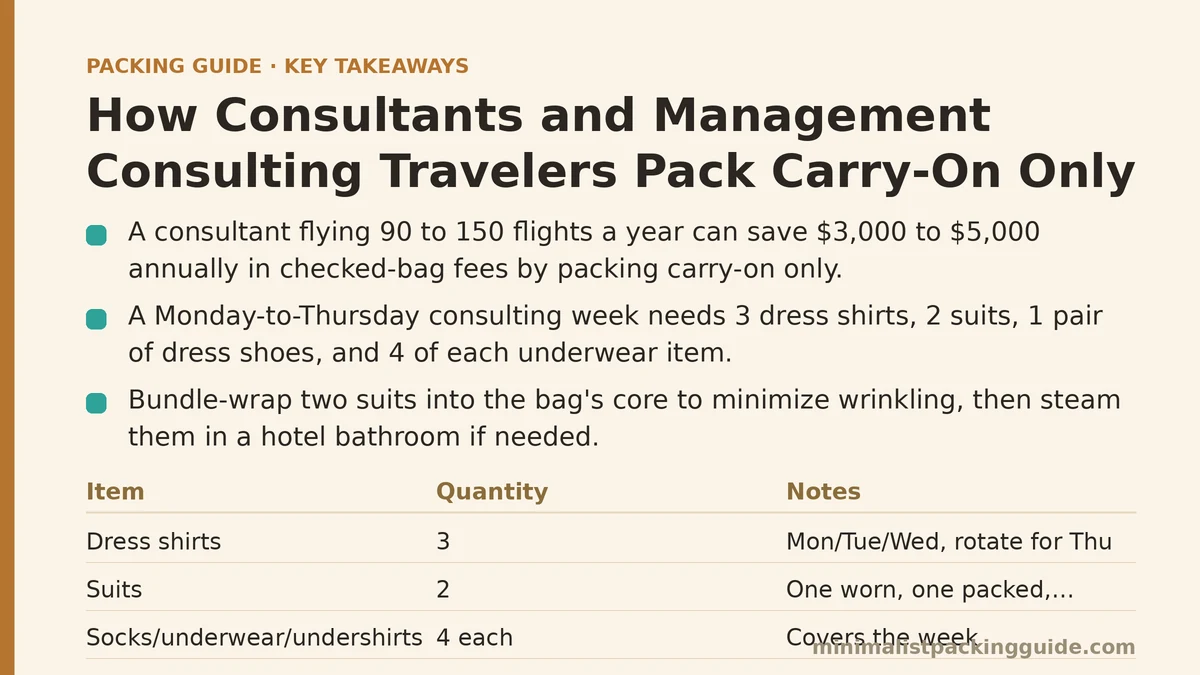
You fly the same route every week. A consultant on a Monday-to-Thursday engagement typically boards 90 to 150 flights a year. A checked-bag fee of $35 each way costs $3,000 to $5,000 annually. At that frequency, an airline credit card that waives the fee pays for itself — but a carry-on avoids the question entirely.
You cannot afford a 30-minute bag wait. Landing at 9:40 p.m. and needing to be at the client site by 8:00 a.m. is survivable. Landing at 9:40 p.m. and waiting 35 minutes at a carousel in a city where your hotel is another 25 minutes away is not, because it eats the buffer you needed for ironing.
Your bag is your office. Laptop, charger, badge, notebook, and the one shirt you need for tomorrow morning all live in the same two items. A gate check breaks that access instantly.
What does a consulting week require in terms of clothing?
The honest answer is fewer items than most first-year consultants pack. A standard Monday-to-Thursday engagement against one client typically needs:
- 3 dress shirts (Mon/Tue/Wed), with Thursday covered by the third shirt rotated or a Thursday-morning change
- 2 suits (one worn, one packed), rotated mid-week
- 1 pair of dress shoes (worn), 1 spare pair of laces
- 1 business-casual outfit for travel days or a Thursday evening team dinner
- 4 pairs of socks, 4 undershirts, 4 underwear
- 1 belt, 1 tie (if the client dress code calls for one), 1 pair of cufflinks
That is roughly 14 to 18 liters of clothing. A 35-to-40-liter carry-on handles it comfortably with room for a laptop sleeve and a toiletry pouch.
How do you pack two suits without wrinkling them?
The bundle-wrap method is the standard answer, and it works because it distributes the fabric’s bulk across the bag’s center rather than concentrating it in folds.
The sequence:
- Lay the jacket face-down, arms folded inward at the shoulders.
- Place the trousers along the jacket’s length, waist at the collar.
- Rollor fold the dress shirts and lay them on top of the trousers.
- Fold the whole bundle once, then place it at the bag’s core, cushioned by rolled casual clothing on all four sides.
A garment bag is the wrong tool here. It either becomes a second carry-on item that some airlines won’t allow alongside a full-size rollaboard, or it gets folded into your main bag anyway, where it is just extra fabric. A suit bundle-wrapped into the bag’s core typically arrives with less wrinkling than the same suit hung in a garment bag that spent four hours pressed against an overhead bin.
If the suit does arrive creased, most hotel bathrooms solve it in 15 minutes: run the shower hot, hang the suit on the door, close the door, and let steam do the work. A travel steamer (most are 300 to 500 grams) is useful but not essential.
What does the bag itself need to look like?
The bag has to satisfy three audiences at once: the airline’s sizer, the client’s lobby, and your own shoulder on a 25-minute walk from the parking garage.
| Feature | Why it matters for consulting | Common mistake |
|---|---|---|
| Legal dimensions (22 x 14 x 9 in / 55 x 35 x 20 cm) | Passes the sizer on nearly all US carriers | Buying a “22-inch” bag that measures 23 in with wheels |
| Soft-sided with compression straps | Compresses visibly when a gate agent squeezes it | Rigid polycarbonate that fails the sizer when overpacked |
| Front-loading or clamshell opening | Lets you reach the suit bundle without unpacking the bag | Top-loading duffels that force full unpacking at the hotel |
| Laptop compartment against the back panel | Protects the laptop and keeps the weight near your spine | Laptop sleeve loose inside, shifting all day |
| Weight under 3 kg empty | Leaves room for 7 kg of contents on a 7 kg carrier | Bags that weigh 4 kg empty and blow the limit immediately |
Wheeled bags are the default, and for good reason — you are moving through airports and client parking garages, not hiking. But check the bag’s empty weight before buying. A 4 kg bag is a liability on any Asian or budget carrier with a 7 kg limit.
What about the personal item — what goes in it?
The personal item is not a backup. It is your in-flight insurance policy. If the bag gets gate-checked, everything in the personal item stays with you, and that determines whether the trip continues smoothly or not.
Put these in the personal item every time:
- Laptop and charger
- Passport, ID, boarding pass, client badge
- Any medication
- Power bank (spare lithium batteries are prohibited in checked bags)
- One dress shirt folded flat, so a Thursday-morning bag delay doesn’t leave you shirtless
- A small toiletry pouch with the items you need on arrival (toothbrush, deodorant, stain pen)
A personal item sized to fit under the seat in front of you — typically 18 x 14 x 8 inches — carries all of that without argument at the gate.
How do you handle laundry on a four-day trip?
The honest answer is: you mostly don’t, and the math on when you should is simple.
| Trip length | Laundry strategy | Cost |
|---|---|---|
| 2–3 days | None needed | $0 |
| 4 days (Mon–Thu) | One mid-week sink wash of undershirts and socks, or use hotel laundry for shirts only | $0–$25 |
| 5 days | Hotel laundry for 2 shirts, or a $15–$30 wash-and-fold near the hotel | $15–$30 |
| 6+ days | One full hotel laundry cycle mid-trip | $40–$80 |
Most consultants find that four days is the break-even point. Below four days, packing the extra shirts is cheaper than laundry. Above four days, laundering two or three shirts mid-trip costs less than the checked bag you’d need to carry a fifth day of clothing.
Sink washing works for undershirts, socks, and underwear — they dry overnight in a hotel bathroom with decent air circulation. Dress shirts do not dry well in a hotel room and are worth sending out.
What are the most common mistakes consultants make on the first switch?
Five show up repeatedly:
1. Packing for the dress code they want, not the one the client has. Confirm the client’s dress code in writing before the first trip. A bank in New York and a tech client in Austin have different expectations, and the wrong call means you either overpack a suit you never wear or spend Monday morning buying one.
2. Bringing three pairs of dress shoes. You need one pair, worn on the plane. A second pair is dead weight. If the shoes get soaked, hotel shoe shine and a hair dryer handle it.
3. Forgetting the gate-fee math. Gate-check fees on budget carriers commonly run $50 to $75 per bag — more than a checked bag purchased online in advance. Packing to avoid the gate check is cheaper than paying the fee once.
4. Treating the personal item as overflow. The moment you start using the personal item for “extras,” you have lost the in-flight insurance policy. It has a job. Let it do that job.
5. Packing to 100 percent of the bag’s volume. A bag packed to its limit has no compression room, and it fails the sizer visibly. The target is roughly 85 percent full, which leaves the fabric able to compress under a gate agent’s hand.
What is a realistic Monday-to-Thursday packing list?
Here is a working list for a standard engagement:
Worn on the plane:
- Suit #1
- Dress shirt, tie (if the dress code calls for it), belt
- Dress shoes
- Undershirt, socks, underwear
In the carry-on:
- Suit #2, bundle-wrapped at the bag’s core
- 2 additional dress shirts, folded flat against the back panel
- 3 undershirts, 3 socks, 3 underwear, rolled
- 1 business-casual outfit (travel-day or team dinner)
- Dopp kit: toothbrush, deodorant, razor, stain pen, lint roller, 1 oz. of each toiletry
- Laptop charger, phone charger, small power strip (hotel outlets are never where you need them)
- One pair of workout clothes if the hotel gym is part of the routine
In the personal item:
- Laptop
- Documents, badge, medication, power bank
- One dress shirt folded flat
- Toiletry essentials for arrival
That list fits a 35-to-40-liter carry-on at roughly 8 to 9 kg. On a 7 kg carrier, move the shoes, chargers, and toiletry pouch into the personal item at the airport — it typically drops the bag 1 to 2 kg in under two minutes.
What if the bag fails the sizer at the gate anyway?
You have three recovery moves, in order:
- Move dense items to the personal item. Shoes, chargers, and the toiletry pouch are the highest-density items in any consulting bag. Relocating them removes 1 to 2 kg and frees the bag’s sides to compress.
- Wear the bulkiest layer. A suit jacket or a sweater worn onto the plane does not count against your allowance on any airline.
- Repack so the bag is flat, not round. The same items redistributed into a flatter profile often pass a sizer that a bulging bag just failed. Structured items go against the back panel; soft items go toward the opening.
If none of those works, knowing the gate fee in advance lets you decide between paying it and removing items before boarding. On a budget carrier, the fee is often $50 to $75 — high enough that removing a pair of shoes and a charger is usually the better trade.
What to do before your next engagement
Three steps you can take today:
- Confirm the client dress code in writing, including whether a suit is required daily or only for client-facing sessions. This single piece of information changes the packing list more than anything else.
- Weigh and measure your bag, packed as you would for a real trip, using a luggage scale and a tape measure. Include wheels and handles in the measurement. If either number exceeds your primary airline’s limit, remove dense items until both are inside.
- Move every in-flight essential into a personal item sized for the seat in front of you — laptop, documents, medication, power bank, and one dress shirt. Confirm the item fits under a seat with the bag at your feet.
A consulting week is one of the most repeated packing problems in business travel. Solve it once, and Monday morning becomes a five-minute routine rather than a Sunday-night negotiation with your closet.
Related guides: How to Pack for a Wedding in a Carry-On Only, Carry-On Packing Mistakes That Trigger Airline Gate Checks, and Carry-On Packing Guide for Finance Professionals on Business Trips.