After reading this guide you will be able to pack a full working trip — scrubs, clinical shoes, credential documents, and personal items — into a single carry-on, and you will know which items belong on your body or in a personal item rather than in the overhead bin. The approach below is built around the realities of healthcare work travel: split shifts, conference days, hospital orientations, and the constant risk that a checked or gate-checked bag arrives without your credentials or your only pair of work shoes.
Nine packing decisions matter more than the rest. They are ranked below from highest to lowest impact, so you can work through them in order and stop when your bag is full.
1. Choose the right bag size before anything else
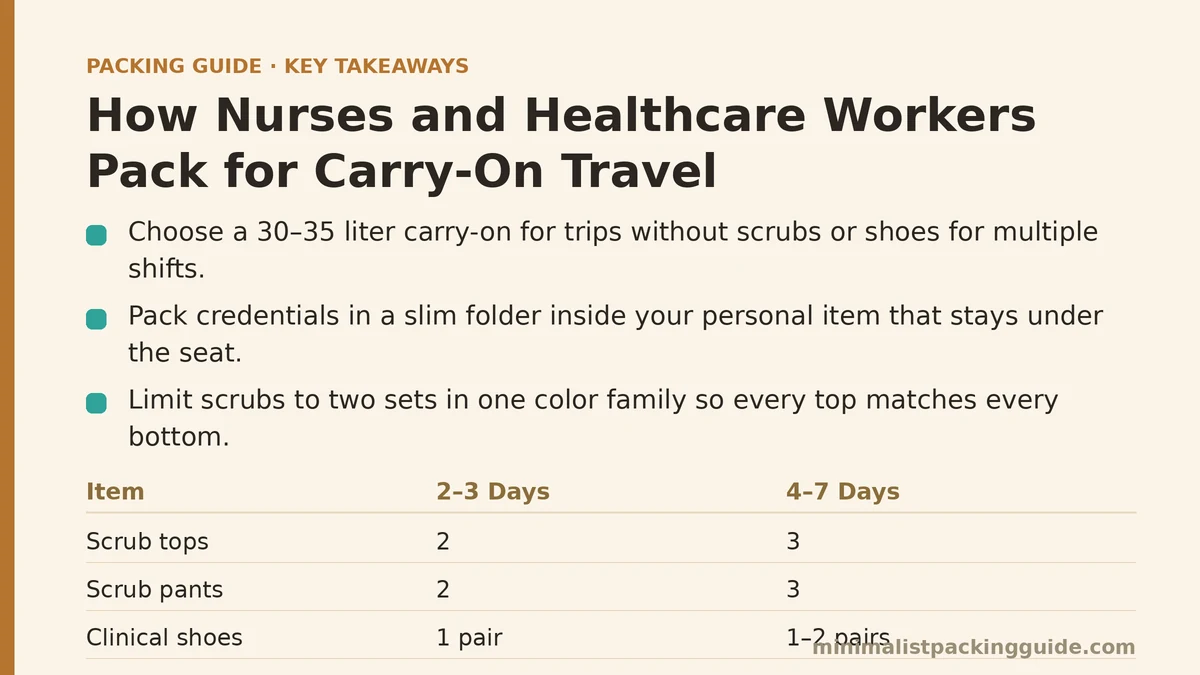
Most healthcare travelers over-buy capacity. A 40–45 liter carry-on is the practical ceiling for a trip that mixes clinical days with off-duty time; a 30–35 liter bag is enough for a two-to-four-day conference or orientation where you are not carrying scrubs and shoes for multiple shifts.
The reason to cap the size is weight, not just airline rules. Clinical shoes alone commonly weigh 400–600 g per pair. Add a stethoscope (150–300 g), two or three scrub sets (250–400 g each), and a toiletry pouch, and a bag that looks half-empty at home can pass 8 kg packed. Several international carriers cap cabin bags at 7 kg, and budget carriers weigh at the gate more often than full-service ones.
If your trip involves a budget carrier: size down to 35 liters and plan to wear your bulkiest shoes on travel days. If your trip is a multi-day conference with no clinical shifts: a 30-liter bag plus a personal item is usually enough.
2. Treat credential documents as a separate, non-negotiable pack
Nothing derails a healthcare work trip faster than arriving without a license copy, a facility badge, immunization records, or a certification card. These items do not belong in the main compartment of a carry-on that could be gate-checked.
Pack them in a slim document folder inside your personal item, which stays under the seat in front of you:
- Printed copy of your professional license and any state or regional registration
- Facility ID, badge, or onboarding paperwork
- Immunization and screening records if the facility requested them
- A digital backup in cloud storage, plus one offline copy on your phone
A paper folder weighs under 100 g and removes an entire category of risk. If your bag is gate-checked, your documents travel with you.
3. Limit scrubs to two sets and one color family
Scrubs are the highest-volume clothing category for most healthcare travelers, and the easiest to overpack. Two sets cover a two-to-three-day clinical block if you wash one overnight; three sets is the realistic maximum for a longer trip without laundry access.
Stick to one color family so every top matches every bottom. That single decision cuts the number of pieces you need by roughly a third compared with packing mismatched sets, and it means a stained top does not orphan a pair of pants.
Packing method that works for scrubs: fold each set flat, then roll it as one bundle with the top wrapped around the pants. Rolls compress better than folded stacks and reduce creasing in the drawstring waistbands.
| Item | Quantity for 2–3 days | Quantity for 4–7 days | Approx. weight each |
|---|---|---|---|
| Scrub tops | 2 | 3 | 150–250 g |
| Scrub bottoms | 2 | 3 | 200–300 g |
| Compression or athletic undershirts | 2 | 3 | 100–150 g |
| Work socks | 2 pairs | 3 pairs | 40–60 g per pair |
| Everyday outfits | 1 | 2 | varies |
4. Bring one pair of clinical shoes, worn on travel days
Clinical shoes are the single heaviest item most healthcare travelers pack, and duplicating them is rarely worth the space. One pair of clean, closed-toe work shoes is enough for a short trip; pack a lightweight pair of packable sneakers or flats for off-duty time instead of a second clinical pair.
Wear the clinical shoes on travel days. They do not count against your bag’s dimensions, and they free 400–600 g of cabin weight for everything else. Stuff the pair you are not wearing with socks or rolled undershirts to hold their shape and place them sole-out along one edge of the bag.
If your facility requires a specific shoe type (non-slip, safety toe, or a particular color): confirm before you fly, and if the requirement is strict, wear that pair and pack only the off-duty shoes.
5. Build a compact hygiene and PPE pouch
Healthcare workers carry a slightly different hygiene kit than leisure travelers: hand sanitizer, a small pack of gloves if your role requires them, a thermometer if the facility asks, and a stain pen for scrub emergencies. Keep all of it in one pouch of roughly 500 ml so it is findable in a dark hotel room and easy to pull out at security.
A workable pouch contents list:
- 60 ml hand sanitizer (within the 100 ml liquids limit)
- Travel-size stain pen or wipes for scrubs
- Small lint roller
- Nail clippers and a small sewing kit
- Any personal medication, in original labeled packaging
- Spare mask or two, if your workplace or flight requires one
If you carry liquid sanitizer in a carry-on: it counts against the 100 ml per-container liquids limit. A 60 ml bottle is safe on nearly every carrier.
6. Pack a stethoscope and small equipment deliberately, not by default
Stethoscopes are the most commonly over-packed clinical item. If your assignment provides one, leave yours at home. If you bring your own, a folding or single-head model weighs 150–300 g and coils into a side pocket without crushing anything.
Decide in advance which equipment is truly yours to carry:
- Bring: stethoscope if not provided, penlight, a small notebook, badge reel, one pen you would be annoyed to lose
- Leave: full PPE stock, heavy diagnostic tools, backup scrubs beyond the third set, a second pair of clinical shoes
- Check with the facility first: whether equipment is issued on arrival
If your bag is near its weight limit: the stethoscope moves to your personal item or around your neck. It is small enough to relocate at the gate.
7. Use a two-layer packing order so work gear does not crush clothing
The most common packing mistake among healthcare travelers is burying footwear and equipment under clothing, then discovering the scrubs are creased and the shoes are hard to reach. Pack in two layers instead.
Bottom layer: clinical shoes sole-out along one edge, stuffed with socks; stethoscope and equipment pouch in the gaps. Top layer: rolled scrub bundles at the center, cushioned by everyday clothing on all sides; hygiene pouch in an interior pocket rather than loose.
The center of the bag is the most protected zone, which is why formal or structured items belong there. Edges are where compression and shifting happen, which is why shoes anchor a corner rather than floating in the middle.
8. Plan laundry around shift length, not trip length
Laundry access changes the math more than trip duration does. A three-day trip with no laundry needs two scrub sets; a seven-day trip with hotel laundry or a washer needs three. Deciding this before you pack removes the most common reason bags end up overstuffed.
If you have laundry access: pack to the two-set column in the table above and add one everyday outfit. If you have no laundry access: three scrub sets, three undershirts, and accept that the bag will be fuller on the return leg. If your shifts run long and you sweat heavily: compression undershirts are lighter and faster to hand-wash than a second scrub top.
9. Keep the items you cannot lose in your personal item
If a gate check becomes unavoidable, some items must come out of the carry-on before you hand it over. For healthcare travelers the list is longer than for most:
- Credential documents and facility paperwork
- Medication, especially anything you need during the flight or on arrival
- Spare lithium batteries and power banks (prohibited in checked baggage on most carriers)
- Laptop, tablet, and phone chargers
- Passport, ID, and boarding pass
Stow all of these in a personal item from the start. Pulling them out at the gate while other passengers board behind you is avoidable scrambling.
What to do next
- Weigh your packed bag today, including shoes and equipment, on a luggage scale. If it is over 7 kg and you are flying a budget or international carrier, move dense items — shoes, chargers, the stethoscope — into your personal item or onto your body.
- Assemble the document folder with your license copy, badge, and any onboarding paperwork, and put it in your personal item, not the main compartment.
- Cut scrubs to two sets and one color family if your trip is three days or shorter, and confirm whether your facility issues equipment on arrival so you can leave your stethoscope at home.
- Check your airline’s exact cabin dimensions and weight limit on the airline’s own site, not the bag manufacturer’s label, and measure your bag’s outer dimensions including wheels and handles.
Related guides: Minimalist Packing Mistakes Carry-On Only Travelers Make, Carry-On Packing Mistakes That Trigger Airline Gate Checks, and A Step-by-Step Guide to Packing Your First Carry-On-Only Trip.