Frequent business travelers who check a bag arrive at their hotel, on average, no faster than the ones who don’t — the extra suitcase mostly just adds a wait at baggage claim and a second thing to lose. That single fact undercuts most of the reasoning behind checked-bag business travel: the idea that a multi-day work trip, with its suits and dress shirts and laptop gear, simply requires more space than a carry-on can offer. It doesn’t. It requires a better sequence for filling the space you already have.
A business trip has a narrower packing problem than most leisure travel, because the wardrobe is more predictable. You know the meeting schedule, you know the dress code, and you know there’s a hotel iron or a hanging closet waiting at the other end. That predictability is exactly what makes carry-on-only business travel achievable — you’re not guessing at conditions, you’re executing a known plan. Here’s how to do it, step by step.
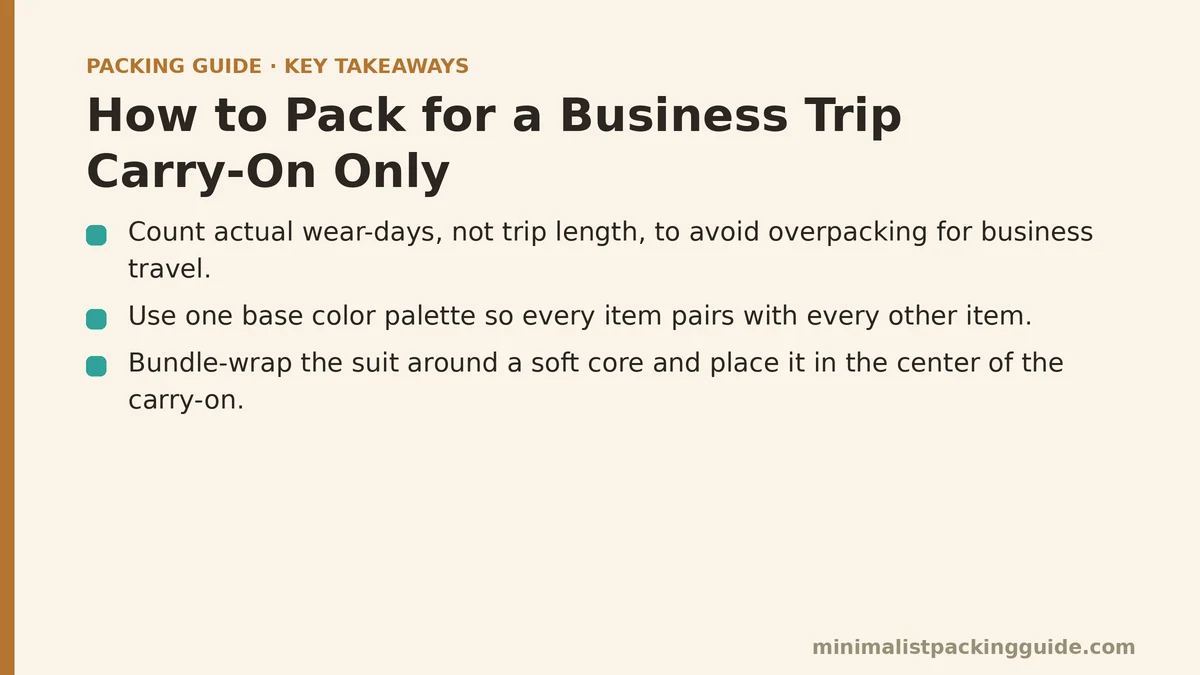
Step 1: Count the Actual Wear-Days, Not the Trip Length
Before touching a single garment, work out how many distinct outfit-days the trip requires. A five-day trip with a hotel laundry option or an evening to hand-wash a shirt doesn’t need five sets of everything — it needs three or four, worn in rotation, with one wildcard for an unplanned dinner or a delayed flight home.
Write this number down before you pack anything. It’s the number that keeps you from grabbing “one more shirt, just in case,” which is the single most common source of business-trip overpacking. Most people pack for the trip length instead of the wear-day count, and the gap between those two numbers is where the extra bag comes from.
Step 2: Choose One Base Color Palette for Everything
Pick a single color anchor — navy, charcoal, or black — and build the entire trip’s wardrobe around it. A navy suit, a charcoal pair of trousers, and two or three shirts in white, light blue, and a single patterned option all cross-match with each other and with a pair of dark dress shoes.
This matters more for business travel than for almost any other trip type, because business wardrobes get judged on consistency, not variety. Nobody in a conference room is tracking whether you wore the same jacket twice. A single palette means every item you pack pairs with every other item, which cuts the total piece count roughly in half compared to packing several unrelated outfits.
Step 3: Fold the Suit Using the Bundle-Wrap Method, Not a Garment Bag
A garment bag solves a problem you don’t have on a business trip: it keeps clothes flat, but at the cost of a second bag or awkward folding inside your existing one. The bundle-wrap method — wrapping the jacket and trousers around a soft core of rolled shirts or a packing cube — compresses the suit into a fraction of the space a garment bag needs, and it arrives with fewer sharp creases than a simple fold-in-half would produce.
Place this bundle at the center of your carry-on, where it’s cushioned on all sides by softer items. That center position matters: it’s the part of the bag least affected by compression and shifting during transit, which is exactly where your one formal piece needs to sit.
Step 4: Build a Shirt Rotation That Survives a Full Day of Meetings
Dress shirts are the piece most business travelers overpack, usually out of a fear of visible sweat or wrinkles by the afternoon. A wrinkle-resistant or performance-fabric dress shirt handles a full meeting day better than standard cotton, and it packs down smaller when rolled rather than folded flat.
Three shirts cover a five-day trip when paired with an evening hand-wash — quick-dry fabric means a shirt washed after dinner is ready by morning. If hand-washing isn’t realistic given your schedule, four shirts is the practical ceiling; a fifth is rarely necessary once you’ve committed to a single color palette that lets shirts mix with more than one suit or trouser combination.
Step 5: Pack Shoes as Structural Anchors, Not Fragile Cargo
Dress shoes hold their shape well and don’t need padded wrapping the way people tend to assume. Stuff each shoe with a rolled pair of socks, and set both pairs — dress shoes and a second casual or walking pair, if the trip calls for one — sole-out along one edge of the bag. They’ll anchor that side and free up the bag’s center for softer, more crushable items.
Two pairs of shoes is the real limit for a business trip: one dress pair worn on the flight, one packed backup or casual pair for evenings and travel days. A third pair is the point where shoes start to consume the space that should go toward your shirt rotation.
Step 6: Separate Your Tech Kit From Your Clothing Kit
Business travel adds a layer that pure leisure trips don’t: a laptop, a charger, presentation materials, maybe a second device for personal use. Keep this gear in its own slim pouch or the laptop bag’s dedicated compartment, rather than letting cables and adapters migrate loose through your main carry-on.
A single compact charging block that handles your laptop and phone from one outlet is worth more than three separate chargers. If the trip is domestic, skip the adapter entirely; if it’s international, one universal adapter covers the outlet mismatch without needing a country-specific version for every stop on a multi-city itinerary.
Step 7: Add a Toiletries Kit Sized for the Actual Trip Length
A five-day business trip doesn’t need full-size toiletries — hotel rooms almost always provide the basics, and anything you specifically need in your own brand travels fine in a container under the standard liquid limit. Solid options — a shampoo bar, a solid deodorant — sidestep the liquid rules entirely and take up less room than their bottled equivalents.
Keep this kit in a single clear pouch near the top of the bag, where it’s quick to pull for security screening and doesn’t require unpacking the rest of the bag to reach.
Step 8: Reserve a Small Reset Kit for the One Unplanned Event
Every business trip has some chance of an unplanned dinner, a spilled coffee before a morning meeting, or a loose button. A stain-removal pen, a small lint roller, and a travel sewing kit weigh almost nothing and cover the realistic range of minor wardrobe emergencies far better than an extra packed outfit would.
This is the step people skip most often, and it’s the reason some travelers add a whole backup outfit “just in case.” A two-ounce kit handles the same risk at a fraction of the volume.
Step 9: Do a Final Compression Pass Before You Zip the Bag
With everything in place — suit bundle at the core, shirts rolled around it, shoes anchoring the edges, tech and toiletries in their own pouches — do one final pass to compress soft items into any remaining gaps. Rolled socks, a folded belt, or a spare tie fit into corners that flat-folded items can’t reach. This last pass is often what separates a bag that barely closes from one with a bit of room to spare for whatever you pick up on the trip.
Business Trip Packing at a Glance
| Step | Focus | Outcome |
|---|---|---|
| 1 | Count wear-days, not trip length | Right number of outfits, not one per day |
| 2 | One base color palette | Every piece mixes with every other piece |
| 3 | Bundle-wrap the suit | Suit fits at the bag’s core without a garment bag |
| 4 | Rotate three to four shirts | Fewer shirts, worn and refreshed as needed |
| 5 | Two pairs of shoes, sole-out | Shoes anchor the bag instead of padding it |
| 6 | Separate tech kit | Cables and chargers stay findable and minimal |
| 7 | Trip-sized toiletries | No full-size bottles for a short stay |
| 8 | Small reset kit | Covers emergencies without a backup outfit |
| 9 | Final compression pass | Uses every remaining gap in the bag |
Related guides: How to Pack for 2 Weeks in a Carry-On Only, Carry-On Packing Guide for Finance Professionals on Business Trips, and One-Bag Packing List for Traveling Sales Reps.