By the end of this guide, you’ll be able to pack for a seven-night cruise — formal night included — in a single carry-on-sized bag, without opening your suitcase mid-trip to wonder what you forgot. That’s the goal, and it’s a realistic one once you understand why cruise packing tends to balloon in the first place.
Cruises have a specific packing problem that land-based trips don’t: you’re committing to a single bag for a week or more, with no laundry access most lines don’t advertise, no easy resupply once you’re at sea, and a dress code that shifts from swim trunks to sport coats within the same 24 hours. That combination pushes people toward overpacking in very predictable ways. Below is a troubleshooting guide to the most common symptoms, what’s actually causing them, and the fix for each.
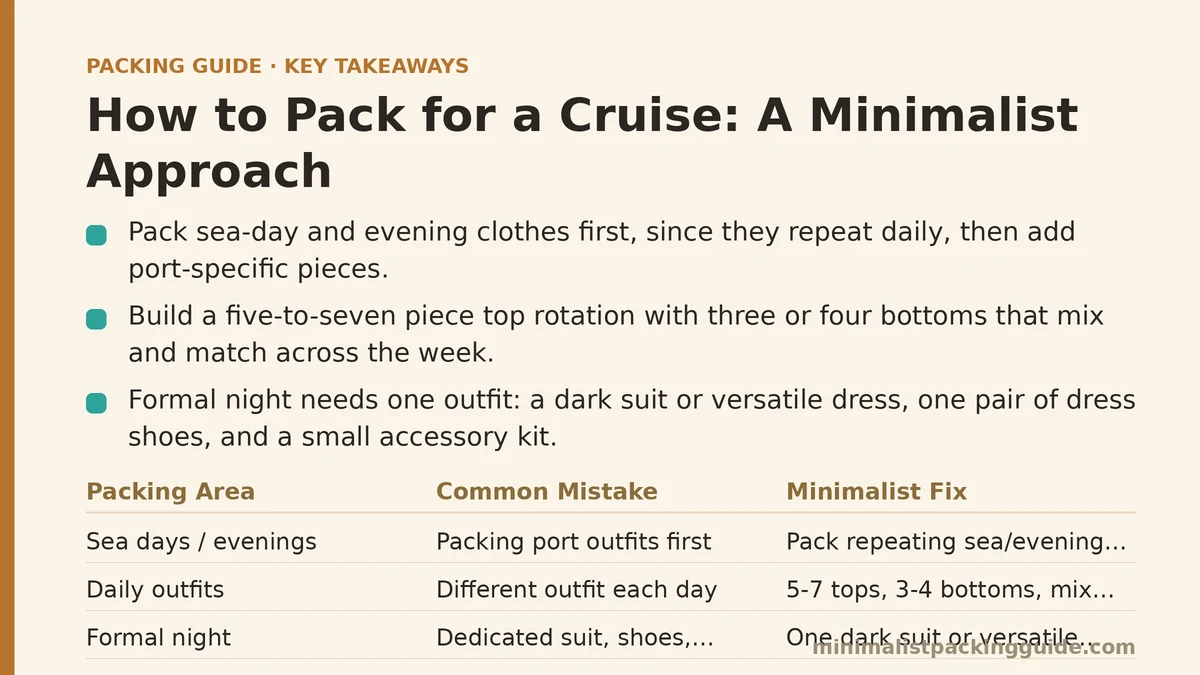
Symptom: Your Bag Is Already Full Before You’ve Packed a Single “At-Sea” Outfit
Cause: Most cruisers pack for the ports first — a full outfit for every excursion day — and only then try to fit in the clothes they’ll wear on sea days, at the pool, and at dinner. Port outfits get planned with intention; everything else gets crammed in afterward.
Fix: Reverse the order. Pack your sea-day and evening rotation first, since those repeat every single day of the cruise regardless of itinerary. Then layer in port-specific pieces, choosing versions that double as sea-day wear when possible (a linen shirt that works at both a beach excursion and a casual dinner, for instance). Ports get the leftover capacity, not the first claim on it.
Symptom: You’re Packing a Different Outfit for Every Day of the Cruise
Cause: Cruise itineraries feel like a string of separate mini-trips — one per port — which nudges people into planning a distinct outfit for each day the way they might for a week of different cities. But a cruise isn’t seven trips. It’s one trip with a rotating backdrop.
Fix: Build a five-to-seven piece rotation of tops and three or four bottoms that mix and match, and repeat them across the week. No one on a ship of two thousand strangers is tracking your outfit repetition, and the laundry-free reality of most cruise cabins means repetition isn’t a compromise — it’s the plan working as intended.
Symptom: Formal Night Is Eating a Third of Your Suitcase
Cause: Formal night gets treated as its own packing category, separate from everything else, which leads to a dedicated suit or dress, dedicated shoes, and dedicated accessories that serve no other purpose on the trip.
Fix: One outfit is enough. A dark suit or a versatile dress, one pair of dress shoes, and a small accessory kit cover every “elegant” or “formal” night most cruise lines schedule (usually one or two per week, not one per day). Fold the outfit using a bundle-wrap or roll technique and place it at the core of the bag, cushioned by your everyday rotation, the same approach that works for weddings and other single-event formal wear.
Symptom: You’re Packing a Full Swim Kit for Every Day at the Pool
Cause: Swimwear feels disposable to plan around — cheap, small, easy to over-provision — so people pack two or three swimsuits, multiple cover-ups, and a stack of towels “just in case,” forgetting that most ships supply pool towels and that swimwear dries fast in cabin air or on a balcony rail.
Fix: Two swimsuits is the real ceiling — one to wear, one drying — plus a single quick-dry cover-up. Skip the towel entirely if your cruise line provides pool towels, which the large majority do. A packable microfiber towel is the only backup worth adding, and only if you’re unsure about ship policy.
Symptom: Your Toiletries Bag Weighs More Than Your Clothes
Cause: Cabin bathrooms are small and travelers overcompensate by bringing full-size bottles of everything, plus backups for the backups, on the assumption that a week at sea means a week without access to anything.
Fix: Solid toiletries — shampoo bars, solid sunscreen, a bar of soap — cut this weight dramatically and sidestep liquid restrictions entirely. For anything that has to stay liquid, travel-size bottles refilled once from your own supply are enough for a week; most cruise cabins have limited shelf space anyway, so smaller containers solve two problems at once.
Symptom: You’ve Packed a Different Bag for Shore Excursions Than the One You Traveled With
Cause: A full-size daypack or secondary tote gets added to the packing list specifically for port days, under the assumption that your travel bag is too large or too formal for a beach excursion or a walking tour.
Fix: A single packable daypack — one that folds flat to almost nothing — handles every excursion from snorkeling to city walking tours, and it stows inside your main bag for the flight there and back. There’s no need for a separate “excursion bag” category; one lightweight, foldable option covers the entire range of shore activities a typical itinerary includes.
Symptom: You’re Bringing a Portable Charger, a Universal Adapter, and Three Types of Cables “to Be Safe”
Cause: Cabins have limited outlets, and the fear of running out of power at sea leads people to pack redundant charging gear well beyond what the trip actually requires.
Fix: One compact power strip or multi-port charging block solves the limited-outlet problem better than duplicate adapters do, since it turns one outlet into several. Bring only the cables your specific devices need, and skip the universal adapter unless your itinerary includes a foreign port where the ship’s outlets themselves don’t already match your plug type — check your line’s cabin specs before assuming you need one.
Symptom: You Packed for Rain, Cold, Extreme Heat, and Formal Dinners, and None of It Fits
Cause: A cruise itinerary spanning multiple climates — a cold departure port, a tropical stop, an air-conditioned dining room — invites packing for every condition at once rather than for the realistic range you’ll encounter.
Fix: Layering beats duplicating. A single packable rain shell, one light long-sleeve layer for air-conditioned interiors and cool evenings, and breathable daywear for warm ports cover the full range without requiring a dedicated outfit per climate. Check your specific itinerary’s weather patterns before the trip rather than packing for every climate you can imagine encountering.
A Practical Cruise Packing Sequence
Start with your sea-day and evening rotation, five to seven mixable pieces. Add the single formal outfit, folded and placed at the bag’s core. Layer in two swimsuits and one cover-up. Add solid toiletries in a small pouch. Pack the foldable daypack flat against one wall of the bag. Finish with your layering pieces — rain shell and light layer — rolled into the remaining gaps. What’s left should be small enough to leave room for whatever you pick up in port.
Cruise Packing: Symptom, Cause, and Fix at a Glance
| Symptom | Underlying Cause | Fix |
|---|---|---|
| Bag full before sea-day outfits are packed | Port outfits planned first | Pack the daily rotation before port-specific pieces |
| A new outfit for every day | Treating the cruise as many trips | Build a five-to-seven piece repeating rotation |
| Formal night dominates the suitcase | Formal wear treated as its own category | One outfit, folded and placed at the bag’s core |
| Overloaded swim kit | Assuming no drying time or towel access | Two swimsuits, one cover-up, check towel policy |
| Heavy toiletries bag | Overcompensating for limited cabin space | Solid toiletries and small refillable bottles |
| Separate excursion bag | Assuming the main bag can’t serve ports | One packable daypack for all shore activities |
| Redundant charging gear | Fear of limited cabin outlets | One power strip, only the cables you need |
| Packing for every climate at once | Multi-climate itinerary anxiety | Layer with a shell and one light layer instead of duplicating |
Which of these symptoms sounds like your last cruise packing list? If you’ve got an itinerary booked and know your ports and formal-night count, tell me the details and I can help you map out exactly what fits in your bag.
Related guides: How to Pack Camera Gear for Travel Photography, How to Pack One Bag for a Trip Across Both Cold and Hot Climates, and How to Pack a Rain Jacket and Stay Dry Without Adding Bulk.