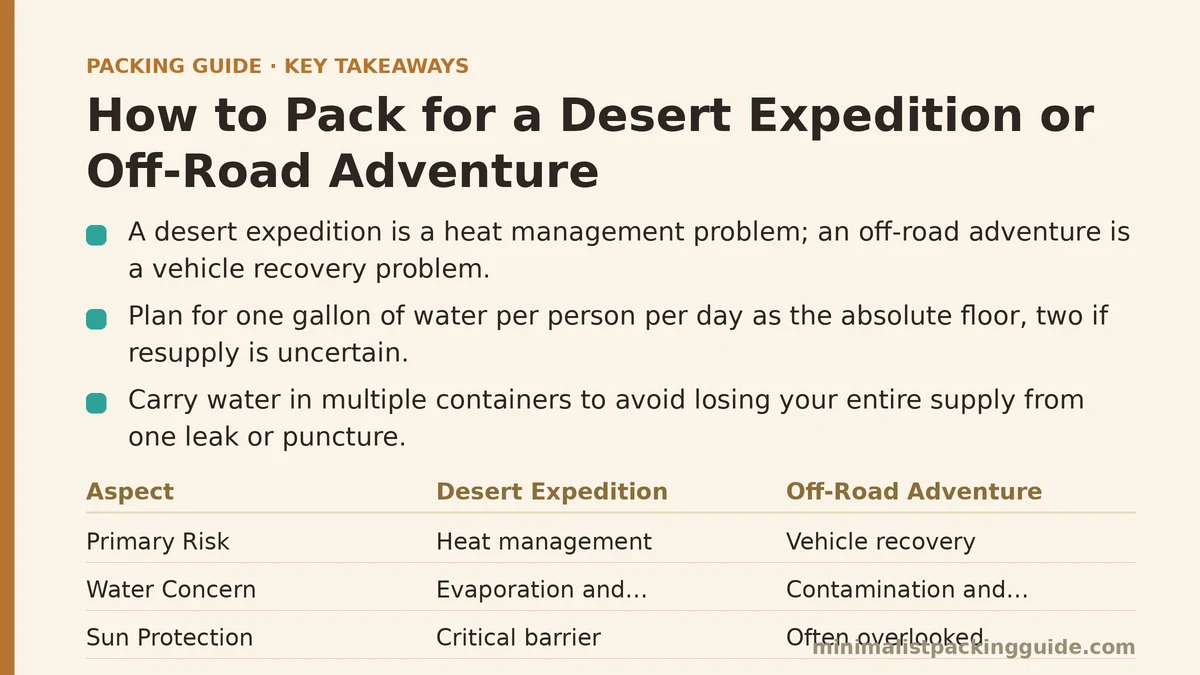
A desert expedition and an off-road adventure get confused because both involve dusty vehicles, remote terrain, and a serious need for water. They are not the same trip. A desert expedition is a heat management problem with some navigation mixed in. An off-road adventure is a vehicle recovery problem with some weather exposure mixed in. Pack for the wrong one and you will either run out of water 30 miles from the nearest shade or watch your only spare tire sink into a mud hole with no jack rated for the job.
The two trips share a foundation: enough water, sun protection, and a way to communicate when cell service drops. Beyond that, the lists diverge sharply. Below is a ranked breakdown of the five most consequential packing decisions for each trip type, the overlap between them, and the mistakes that cost people the most time and comfort.
1. Water: The Single Non-Negotiable, With Different Rules
Desert expedition: Plan for one gallon per person per day as the absolute floor, and carry two gallons per person per day if your route has any chance of a missed resupply. A 110°F day with dry air and physical exertion will push a person through a gallon faster than most people expect. That is not a theoretical figure — it is the average consumption rate for moderate activity in extreme heat, and it climbs with pack weight and direct sun exposure. Carry water in multiple containers, not one large jug. A single 5-gallon container that springs a leak or gets punctured on a rock face leaves you with zero water, not five gallons. Two 2.5-gallon containers or four 1-gallon jugs distributed around the vehicle give you redundancy and spread the weight.
Off-road adventure: The same gallon-per-day floor applies, but your risk profile shifts from evaporation to contamination. Mud, creek crossings, and dusty trails create opportunities for water to get dirty or for containers to get dropped and cracked. Add a portable water filter or purification tablets to your kit even if you plan to carry all your water. A 20-ounce squeeze filter weighing under three ounces turns a muddy puddle into drinkable water in about a minute. In a desert, that filter is a backup tool. In an off-road setting, it is often the primary source after the second day.
The mistake: Packing water based on the distance of the drive rather than the number of days you might be stranded. A 200-mile trail can take three days if you hit a washout or a broken axle. Water for the drive is not water for the trip.
2. Sun and Heat Protection: The Desert’s Edge, and the Off-Roader’s Blind Spot
Desert expedition: Sun protection is not a convenience item; it is the difference between a functional day and a recovery day. A wide-brim hat with a neck flap, UV-rated sunglasses with side coverage, and a lightweight long-sleeve shirt with UPF 50+ rating outperform any sunscreen application schedule. Sunscreen gets sweated off, rubbed off, and forgotten. A physical barrier does not. Carry sunscreen as a backup for exposed skin — hands, neck, face — but do not plan around it as your primary defense. Add a lightweight scarf or shemagh that can be wet and worn around the neck; evaporative cooling in dry air drops the temperature of the blood passing through that area by several degrees, which measurably reduces heat stress during midday exertion.
Off-road adventure: The same physical barrier rules apply, but the off-road context adds a twist: you are often in and out of the vehicle, exposed to sun during recovery operations, tire changes, and trail scouting. The wide-brim hat that works in the desert still works here, but you also need eye protection that stays put when you are leaning over an engine bay or crawling under a chassis. A strap on your sunglasses or a pair of wraparound safety glasses with UV protection is worth the minor annoyance. Sunglasses that fall off when you are winching a vehicle out of a ditch are not protection; they are a liability.
The mistake: Treating sun protection as a single-item category — a bottle of SPF 50 in the glovebox. In both environments, a physical layer plus a hat plus eye protection beats any sunscreen routine, and it does not need to be reapplied every two hours.
3. Vehicle Recovery vs. Navigation: Where the Lists Split
Desert expedition: Your primary vehicle risk is getting stuck in sand or silt. A set of traction boards (two lightweight plastic boards rated for your vehicle’s weight) is the highest-value recovery item you can carry. They work without external power, without a second vehicle, and without digging. A compact shovel is the second item. Sand ladders and a shovel solve the majority of desert high-centering situations faster than a winch, because a winch needs an anchor point that sand does not provide. Navigation is straightforward: a GPS unit with pre-loaded topo maps, a paper map of the same area as backup, and a compass. GPS batteries fail in extreme heat faster than in temperate conditions — a paper map and compass weigh four ounces and eliminate the single point of failure.
Off-road adventure: Your risks are mud, rocks, and the possibility of a mechanical failure that leaves you immobile. A winch with a proper anchor point (a ground anchor or a second vehicle) is the difference between self-recovery and waiting for a tow. A high-lift jack rated for your vehicle’s weight is the second item — it can lift a vehicle out of a mud hole, change a tire on uneven ground, and even winch in a pinch with the right accessories. Recovery straps (rated for double your vehicle’s weight) and a set of shackles complete the minimum kit. Navigation in off-road terrain is more forgiving than open desert — landmarks, trail markers, and a decent phone GPS app with offline maps usually suffice — but a paper map of the trail system is still the backup that costs nothing to carry.
The mistake: Packing recovery gear for the wrong terrain. Traction boards do nothing for a vehicle stuck axle-deep in mud, and a winch does nothing for a vehicle high-centered on a sand dune with no anchor point. Know your terrain before you pack, and carry the gear that solves that specific failure mode.
4. Clothing the Two Trips Share: The Capsule That Works
Both trips boil down to a single repeating clothing rotation that covers day and night temperature swings, dust, and the occasional wet event. Build this seven-item core and it serves either expedition.
| Item | Why It Works |
|---|---|
| 3 lightweight long-sleeve shirts (UPF 50+) | Sun barrier during the day, dust barrier always |
| 2 pairs of quick-dry convertible pants | Zip-off legs turn them into shorts for afternoon heat |
| 1 insulating mid-layer (fleece or lightweight puffer) | Desert nights drop 30-40°F from daytime highs |
| 1 packable rain shell | Off-road mud and unexpected summer storms; also blocks wind at night |
| 2 pairs of wool socks | Moisture-wicking, odor-resistant, wear multiple days |
Footwear is the one real split. Desert expeditions favor a lightweight, breathable boot or trail shoe with a stiff sole for walking on packed sand and rocky washboard surfaces. Off-road adventures favor a higher-cut boot with ankle support, because recovery work involves uneven ground, mud, and the possibility of stepping into a hole while winching or spotting. If you are doing both on one trip, pick the off-road boot — it handles the desert’s walking demands adequately, but the desert shoe will not protect your ankles during vehicle recovery.
5. The Four Items That Rescue Bad Trips, Ranked by Frequency of Use
These four items get pulled out more than any other piece of gear on both trip types, and they are the ones people consistently leave behind.
1. A headlamp. Both trips have a 6 PM sunset in winter months and a 7:30 PM sunset in summer. Recovery work, trail scouting, and camp setup all run past dark more often than people plan. A headlamp with a red mode (preserves night vision) and a spare set of batteries weighs four ounces and gets used every single night.
2. A satellite messenger or personal locator beacon. Cell coverage in both desert and off-road terrain is unreliable or absent. A satellite messenger with two-way texting costs around $150-300 and a monthly plan of $25-50, and it turns a stranded situation into a communicated rescue. A personal locator beacon is a one-time purchase (~$300) with no monthly fee, but it only sends a distress signal — no two-way communication. For group trips in known trail systems, a beacon suffices. For solo or unfamiliar routes, the messenger is worth the subscription.
3. A well-stocked first aid kit, extended for environment. Desert-specific additions: electrolyte packets (heat exhaustion hits faster than most people anticipate), a snake bite kit (compression bandage, not a suction device), and blister care supplies. Off-road-specific additions: a trauma kit with a tourniquet and hemostatic gauze, since vehicle recovery and mechanical work create sharp-metal and crush injury risks that hiking does not. A $30-50 investment in the right version of this kit prevents the worst-case scenario from being worse.
4. A tire repair kit and compressor. This is the highest-frequency mechanical failure on both trip types. A plug-and-patch kit costs under $20, fits in a pouch, and repairs most punctures in 15 minutes. A 12V compressor that plugs into the vehicle’s accessory outlet costs $40-80 and restores tire pressure after a repair or after airing down for soft sand. On a desert expedition, airing down tires to 15-18 psi for sand traction is standard practice — the compressor is what gets you back to highway pressure at the end of the trail.
The Practical Packing Sequence for Either Trip
Start with the seven-item clothing capsule, rolled and packed into a medium duffel or two 35-liter dry bags. Add the water supply in distributed containers, placed against the vehicle’s interior walls to keep weight low and stable. Pack the recovery or navigation kit specific to your terrain next — traction boards and shovel for desert, winch accessories and high-lift jack for off-road. Add the four rescue items (headlamp, satellite messenger, first aid kit, tire repair kit) in a single accessible pouch, not buried at the bottom of the load. Finish with the sun protection layer — hat, sunglasses, scarf — worn rather than packed, so they are guaranteed to be on your body when you step out of the vehicle.
Before You Leave: A 10-Minute Checklist
- Water: multiple containers, 2+ gallons per person per day, filtration backup for off-road
- Sun protection: wide-brim hat, UV sunglasses with strap, UPF long-sleeve shirt worn, scarf for neck
- Recovery kit: traction boards + shovel for desert, winch + high-lift jack + straps for off-road
- Navigation: primary GPS or phone app, paper map backup, compass
- Clothing: 7-item capsule, wool socks, off-road boots if in doubt
- Rescue items: headlamp, satellite messenger or beacon, extended first aid kit, tire plug kit + compressor
- Vehicle check: tire pressure set for terrain, spare tire verified, jack rated for vehicle weight
If you are packing for a specific trip this week and know your terrain, your vehicle, and how many people are coming, describe it and I can help you cut the list down to the exact items that matter for your route.
Related guides: How to Pack Camera Gear for Travel Photography, How to Pack One Bag for a Trip Across Both Cold and Hot Climates, and How to Pack a Rain Jacket and Stay Dry Without Adding Bulk.