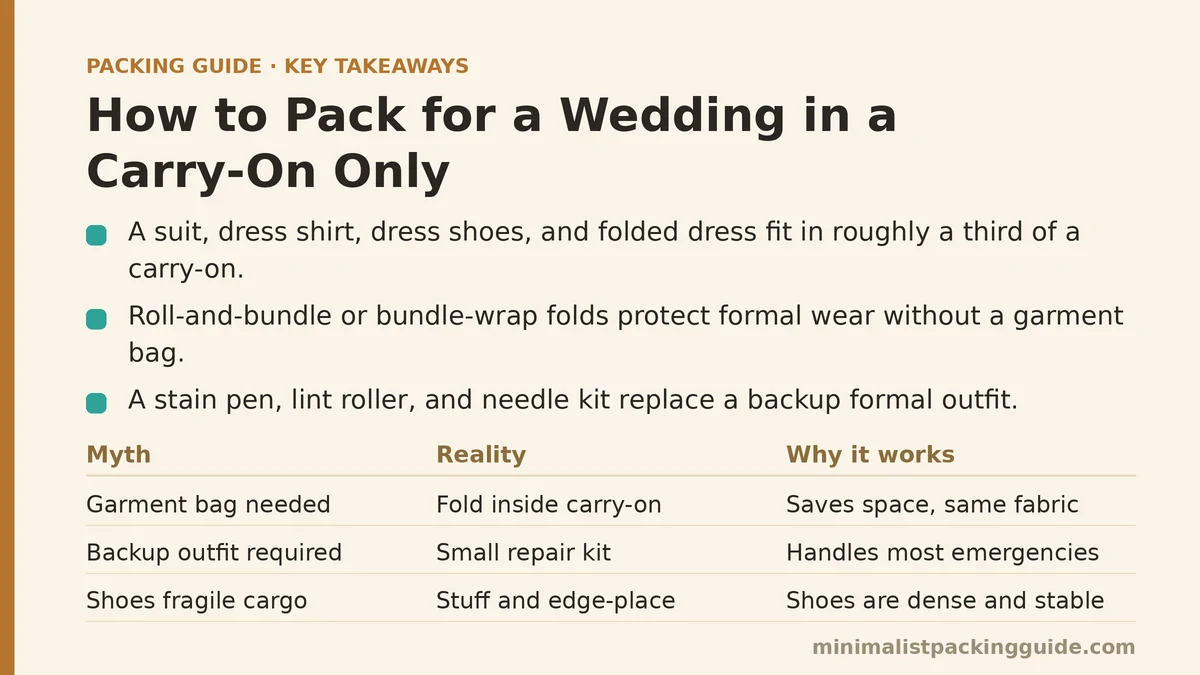
A full suit, a dress shirt, dress shoes, and a folded dress can fit into roughly a third of a standard carry-on, once you strip away the padding most people build in around formal wear. That number surprises almost everyone who’s tried to pack for a wedding, because the assumption going in is usually the opposite: formal clothing is bulky, wrinkle-prone, and simply doesn’t compress the way casual travel clothes do. It does compress. The bulk isn’t in the garments — it’s in the myths people carry about how those garments need to be handled.
Wedding travel has a bad reputation among carry-on packers, and that reputation is mostly earned by bad assumptions rather than bad math. Below are the myths that cause the overpacking, matched against what actually holds up.
Myth: Formal Clothing Requires a Garment Bag
The garment bag is the default reach for most people planning wedding travel, and it makes sense on the surface — it’s the tool built specifically for hanging clothes flat. The problem is what it costs you. A garment bag either becomes a second carry-on item (which many airlines won’t allow alongside a full-size carry-on) or it gets folded down into your existing bag anyway, at which point it’s just extra fabric taking up space without doing the one job it was designed for.
Reality: A suit or dress folded using the roll-and-bundle method, or the standard bundle-wrap technique, survives a flight with less wrinkling than most people expect, and it does so inside your existing carry-on rather than alongside it. The garment bag isn’t solving a packing problem. It’s just relocating the same volume of fabric into a container that takes up its own space.
Myth: You Need a Dedicated Backup Outfit
A surprising amount of wedding overpacking comes down to fear of a single stain or a single tear ruining the one formal outfit you brought. That fear leads people to pack a second full formal outfit “just in case” — doubling the most space-intensive category in the entire bag to cover a low-probability event.
Reality: The actual risk here isn’t outfit failure, it’s the absence of a plan for outfit failure. A small stain-removal pen, a portable lint roller, and a needle-and-thread kit weigh almost nothing and cover the overwhelming majority of last-minute wardrobe emergencies. A full backup suit or dress addresses a risk that a two-ounce kit already handles for a fraction of the space.
Myth: Dress Shoes Have to Be Packed Separately, Wrapped and Padded
Dress shoes get treated like fragile cargo more often than any other item on a wedding packing list. People wrap them in multiple layers of cloth, dedicate a whole section of the bag to them, and worry about them crushing everything nearby.
Reality: Dress shoes are dense and shape-stable — they hold their form better than almost anything else you’re packing. Stuff them with socks or a rolled belt to preserve shape, place them sole-out along one edge of the bag, and let them anchor that corner rather than floating in a padded pocket of their own. The padding isn’t protecting the shoes. It’s protecting an assumption that shoes are more fragile than they are.
Myth: Formal Wear Can’t Share Space With Everyday Clothes
There’s a persistent instinct to keep “wedding clothes” and “regular travel clothes” in separate zones of the bag, as though mixing them will somehow damage the formal pieces or make the whole bag harder to manage.
Reality: Formal wear folded correctly and placed at the core of the bag — where it’s protected from the compression and shifting that happens near the edges — coexists fine with everyday clothing packed around it. Rolled t-shirts and casual pants make reasonably effective cushioning for a folded suit or dress at the center of the bag. Separating them buys you nothing beyond the illusion of extra care.
Myth: One Wedding Outfit Means You Need Wedding-Specific Everything
Once people commit to bringing formal wear, they tend to extend that formality outward — a second pair of formal shoes for “just in case,” a formal-only belt, cufflinks and accessories duplicated across scenarios that will never actually arise on a short trip.
Reality: One well-chosen formal outfit, one pair of dress shoes, and a small accessory set (belt, one set of cufflinks if needed, a tie or two if your suit calls for variety) covers a wedding and any adjacent formal event on the same trip. The instinct to over-provision for a single event category is the same instinct that inflates every other part of a minimalist packing list — it just shows up here with more visible bulk because formal wear is bulkier per item to begin with.
A Practical Formal-Wear Packing Sequence
Fold the suit or dress using a bundle-wrap or roll technique and place it at the core of the bag, cushioned by rolled everyday clothing on all sides. Stuff the dress shoes with socks and lay them sole-out along one edge. Tuck the stain pen, lint roller, and needle-and-thread kit into a small pouch rather than loose in the bag, where they’ll migrate and become hard to find. Add the accessory set last, in whatever gaps remain — it’s small enough to fit almost anywhere.
Quick Reference: Myth vs. Reality
| Myth | Reality |
|---|---|
| Formal wear needs a garment bag | Bundle-wrapped or rolled formal wear fits inside your existing carry-on |
| Pack a full backup outfit | A small emergency kit covers the realistic risks at a fraction of the space |
| Dress shoes need heavy padding | Dense, shape-stable shoes just need stuffing and an anchor position |
| Formal and casual clothes must stay separate | Casual clothing works as cushioning for formal pieces at the bag’s core |
| One event means duplicated formal accessories | One outfit, one pair of shoes, and a small accessory set is enough |
Which of these myths has shaped how you’ve packed for formal events in the past? If you’ve got a wedding on the calendar and a specific outfit in mind, describe it and I can help you work out exactly how it folds down into your bag.
Related guides: A Step-by-Step Guide to Packing Your First Carry-On-Only Trip, Minimalist Packing Mistakes Carry-On Only Travelers Make, and Carry-On Packing Guide for Finance Professionals on Business Trips.