By the end of this guide, you will be able to pack for a week-long yoga or wellness retreat in a single carry-on and a small daypack, with room to spare for the journal, the extra book, and the souvenir ceramic bowl you will absolutely buy on the last day. That is the goal, and it is achievable once you stop packing for a vacation you have taken before and start packing for the specific rhythm of a retreat: early mornings, sweat, bare feet, and a lot of sitting still.
Retreats share a packing problem with cruises and weddings — the temptation to over-provision for every imagined scenario — but the failure modes are distinct. You are not packing for formal dinners or shore excursions. You are packing for movement, stillness, and the occasional rainy afternoon spent staring at a misty hill. Below is a troubleshooting guide to the most common symptoms of retreat overpacking, what drives each one, and the fix that works.
Symptom: You’ve Packed a Different Outfit for Every Yoga Session
Cause: Retreat schedules list two or three practices per day — morning vinyasa, afternoon yin, maybe a sunset meditation — and each block feels like its own event. That structure nudges you into planning a fresh outfit for every single practice, the way you might plan outfits for a week of business meetings.
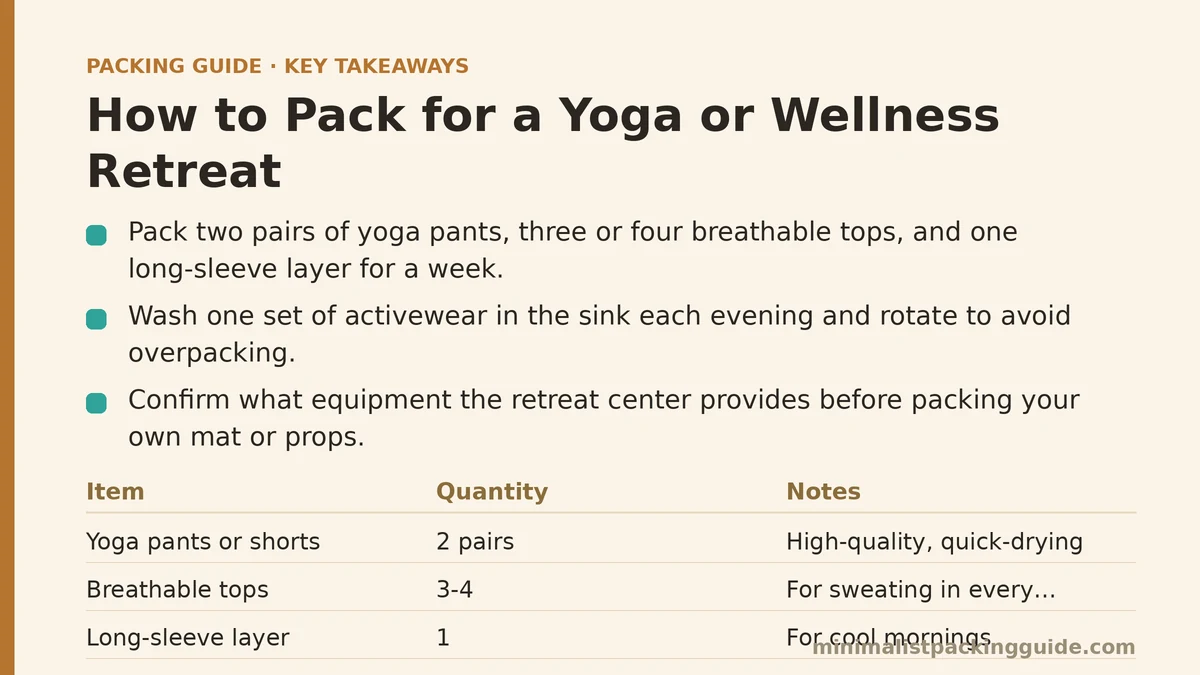
Fix: You will sweat in every single session, which means every piece of activewear will need to be washed or air-dried regardless of how many you bring. Two pairs of high-quality yoga pants or shorts, three or four breathable tops, and one lightweight long-sleeve layer for cool mornings cover an entire week. Wash one set in the sink each evening — most retreat centers have a basin or you can use your shower — and rotate. Nobody on a retreat is tracking whether you wore the same leggings on Tuesday and Thursday. They are tracking their own breath.
Symptom: You’ve Packed a Full Skincare Arsenal for a Week in the Woods
Cause: Wellness retreats trigger an ironic response: the more the environment is about stripping back to essentials, the more people pack to compensate. The result is a toiletry bag that weighs more than the clothes, filled with serums, masks, specialty cleansers, and a backup of every bottle “in case the retreat center doesn’t have it.”
Fix: The retreat center will have soap, shampoo, and often lotion. Pack only what your skin requires that it cannot provide. For most people, that is a simple cleanser, moisturizer, sunscreen, and lip balm — in solid or travel-size form. A week of morning yoga and evening meditation does not require a 12-step routine, and the retreat environment is the one place where cutting back is the entire point. If you have a specific skin condition, bring the one product that manages it, not the whole shelf.
Symptom: You’re Carrying a Separate Mat, Towel, and Block Collection
Cause: The instinct to bring your own equipment is strong — your mat is familiar, your block is the right density, your towel has the grip pattern you trust. But retreat centers universally supply mats, blocks, straps, and bolsters as part of the package. You are paying for that equipment whether you use it or not.
Fix: Call or email the retreat center before you pack and confirm exactly what they provide. In the overwhelming majority of cases, the answer is “everything except your personal mat towel.” If you have a strong preference for a particular mat, a thin travel mat (which folds flat and weighs under two pounds) is the only version worth bringing. A regular full-size mat does not belong in a carry-on. It belongs in a car trunk. The one piece of equipment worth packing is a thin, quick-dry yoga towel — it fits in a side pocket and solves the hygiene question without adding bulk.
Symptom: You’ve Packed for “After Yoga” as a Separate Wardrobe
Cause: Retreat schedules include free time, meals, and evening circles, and each of those feels like a different dress code. Morning practice wear, afternoon exploration wear, dinner wear, evening meditation wear — the categories multiply until you are packing for four different trips.
Fix: One capsule does the work. Three or four comfortable, loose-fitting pieces — a pair of linen pants, a soft dress, a couple of breathable tops — that transition from an afternoon walk to a group dinner to a silent meditation. The beauty of a retreat is that the dress code is “comfortable and present.” The only outfits that need to be distinct are your activewear (for practice) and everything else (for the rest of the day). Two categories, not six.
Symptom: You’ve Packed Three Pairs of Shoes (and a Pair of Sandals “Just in Case”)
Cause: Retreats involve walking on uneven ground, standing on a mat, and sitting cross-legged on a floor — three different surfaces that feel like they require three different types of footwear. Add a pool or a beach nearby and the shoe count explodes.
Fix: Two pairs maximum. One pair of supportive walking shoes for hikes, excursions, or any distance walking. One pair of comfortable, grippy sandals that work for the beach, the shower, and walking around the retreat center. You will practice yoga barefoot, so mats and studios require zero footwear. If the retreat includes a pool or hot springs, the sandals cover that. If it includes a cold-weather hike, the walking shoes cover that. Three pairs is the point where the shoe bag starts eating the clothing budget.
Symptom: You’ve Packed a Full Journaling Station — Multiple Notebooks, a Laptop, and a “Digital Detox” Book
Cause: Retreats are marketed as transformational, and that promise makes people pack for the transformation they imagine rather than the retreat they booked. Three notebooks, a hardcover book on mindfulness, a laptop “in case inspiration strikes” — the mental clutter starts before you leave.
Fix: One notebook. One pen. That is the entire writing kit. The transformation does not require a separate notebook for morning pages, evening reflections, and class notes — you will use one or abandon all three. For reading, one physical book is enough; if you finish it, the retreat center likely has a library or a swap shelf. Leave the laptop at home unless your work requires it, and if it does, ask yourself whether the retreat is the right week for that work. The digital detox works better when the devices are not in the room.
Symptom: You’ve Packed for Every Climate You Can Imagine, Not the One on the Forecast
Cause: A retreat itinerary that includes a cool mountain base, a hot practice room, and an air-conditioned dining area invites the same response as a multi-climate cruise: pack for all of them simultaneously.
Fix: Check the specific location’s weather for the actual dates of your retreat — not the climate of the region in general — and pack a layering system. One packable rain shell, one light fleece or long-sleeve layer, and your regular practice wear handle the full range of a typical retreat week. The sweat from practice is the one constant, and it is best managed with quick-dry fabrics, not by packing a separate outfit for every degree of temperature.
A Practical Retreat Packing Sequence
Start with your activewear rotation — two pairs of bottoms, three to four tops, one long-sleeve layer — and place it at the core of your bag. Add the capsule wardrobe (three or four loose, comfortable pieces) rolled into the gaps. Pack one notebook and one pen in the outer pocket. Add solid toiletries in a small pouch, and finish with your two pairs of shoes anchored along the edges. The travel yoga towel folds flat against the back panel. What remains in the bag is space for the journey home.
Retreat Packing: Symptom, Cause, and Fix at a Glance
| Symptom | Underlying Cause | Fix |
|---|---|---|
| A different outfit for every yoga session | Treating each practice block as its own event | Two practice outfits rotated with sink washes |
| A full skincare arsenal | Overcompensating for the retreat setting | Travel-size basics plus one specialty product if needed |
| Mats, blocks, and towels from home | Assuming the center won’t supply equipment | Confirm with the center; at most, pack a thin travel mat and towel |
| Separate wardrobe for every “after yoga” block | Multiplying dress codes in your head | One capsule of loose, versatile pieces |
| Three pairs of shoes | Assigning a different shoe to every surface | Walking shoes plus grippy sandals |
| A full journaling station and laptop | Packing for the transformation, not the retreat | One notebook, one pen, one book |
| Packing for every climate at once | Missing the specific forecast | Check the dates, pack a shell and a fleece, layer the rest |
Which of these symptoms shows up in your travel history? If you have a retreat on the calendar and a specific practice schedule from the center, describe it and I can help you map out exactly what belongs in your carry-on — and what stays home.
Related guides: How to Pack Camera Gear for Travel Photography, How to Pack One Bag for a Trip Across Both Cold and Hot Climates, and How to Pack a Rain Jacket and Stay Dry Without Adding Bulk.