Most trekkers believe altitude demands more gear, not less. They add a heavier parka, a second pair of boots, a dedicated summit pack, and a backup pile of cold-weather layers — and then they hit the trail overweight, over-warm, and over-burdened, blaming the altitude for a problem their packing list created. The correction is counterintuitive but consistent: high-altitude travel punishes excess weight more severely than it punishes missing gear, because every extra kilogram costs you oxygen, energy, and warmth at exactly the moment you need all three. The best mountain packing lists are short on volume and long on versatility.
Rather than walk through a generic gear list, here is the five-piece hierarchy that decides whether your bag succeeds or fails above 3,000 meters. Each item in this ranking either multiplies the value of the gear around it or caps the damage when conditions turn. Ranked from highest impact to lowest.
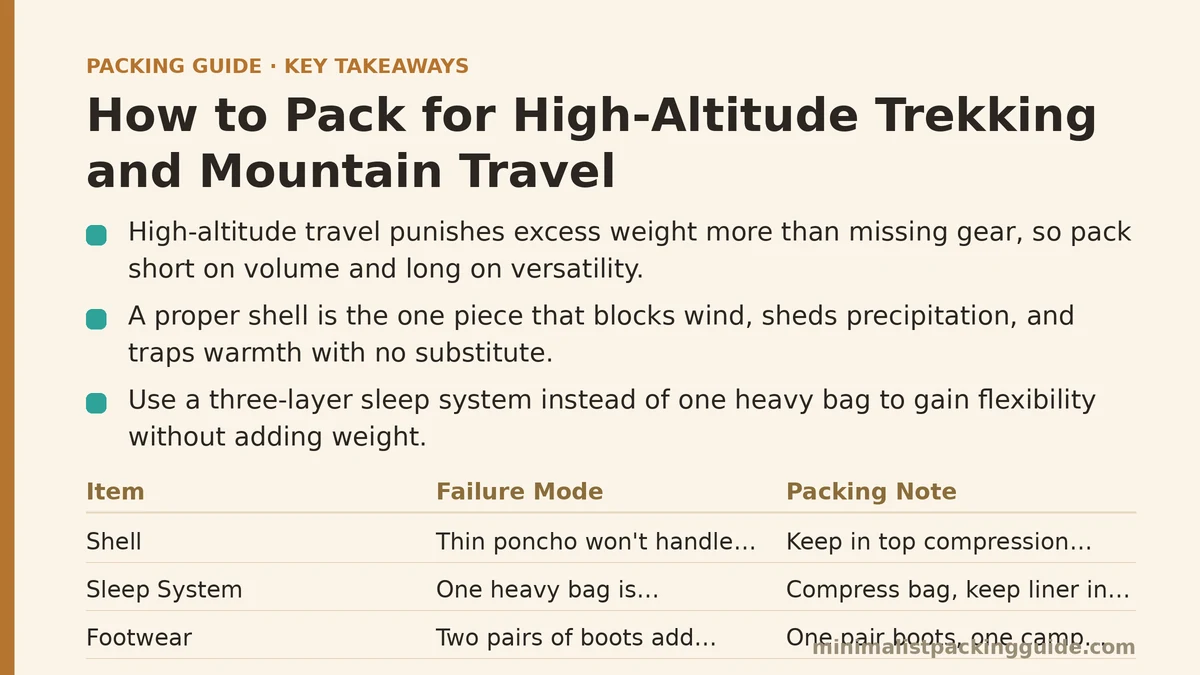
1. The Shell — Your Single Most Versatile Layer
The shell is the one piece of mountain gear that has no substitute, and it earns its rank by solving three separate problems with one garment. It blocks wind, sheds rain and snow, and traps a warm air layer against your body. Everything else in your bag can be replaced by another layer you already own — a fleece can act as a midlayer, a long-sleeve shirt can act as a baselayer — but a proper hardshell or a high-quality softshell with a membrane does the one job no other garment can: it keeps you dry in sustained precipitation without adding bulk.
The failure mode: Trekkers pack a rain jacket as an afterthought, a thin plastic poncho meant for a city commute, and assume it will handle a mountain storm. It won’t. A mountain shell needs a hood that fits over a helmet or hat, pit zips for ventilation, and a hem that covers your hips. Test your shell in a heavy shower before the trip, not during it.
Packing note: The shell lives in the top compression pocket of your bag, never buried in the main compartment. It is the single most likely item to be needed mid-day, in the cold, while you are wearing every other layer you own and cannot afford to unpack the entire bag to find it.
2. A Three-Layer Sleep System — Not a Heavier Sleeping Bag
Altitude cold is a night problem. At high elevation, temperatures drop sharply after sunset, and the difference between a comfortable night and a miserable one can hinge on a few hundred grams of insulation. But trekkers consistently solve the wrong problem, buying a -20°C expedition bag when a -10°C bag plus a liner plus a down jacket worn inside it covers the same range for a fraction of the weight and volume.
The failure mode: One thick bag is heavy, expensive, and single-purpose. A three-layer system — a light-to-mid sleeping bag, a silk or fleece liner, and wearing your down jacket to bed — lets you mix and match across a range of conditions. On a mild night, skip the jacket. On a freezing one, add it. You gain flexibility without carrying a second bag.
Packing note: Compress the sleeping bag into a vacuum sack, but keep the liner folded flat against the inside of your pack lid. The liner is what you’ll use on the tent floor for cleaning gear or as an emergency layer during the day.
3. Footwear: One Pair of Boots, One Pair of Camp Shoes
Two pairs of trekking boots is the most common weight mistake on any high-altitude trip. A second pair of boots solves a problem that rarely exists — boot failure mid-trek — at the cost of more weight, more pack volume, and more time spent breaking in a second pair. Instead, one broken-in pair of supportive trekking boots, paired with one ultralight pair of camp shoes or sandals, covers every foot need.
The failure mode: Trekkers pack a heavy second pair of boots “for the summit” or “for camp” and then end up carrying four pounds of unused leather up and down valleys. The camp shoes aren’t just for comfort; they let your boots air out while you’re walking around the tent, which prevents the damp-foot problem that leads to blisters and trench foot at altitude.
Packing note: Wear the boots on the flight to the trailhead. The camp shoes go in the bag, flat against one side. This is the single biggest weight reduction you can make in the footwear category, and it costs you nothing in real capability.
4. A Water System That Works Without Filtration
At altitude, clean water is not a given. High mountain streams and glacier melt look pristine but can carry giardia, cryptosporidium, and other pathogens that a trekker’s gut cannot handle. The solution is not a heavy filtration pump — it is a lightweight UV purifier or a collapsible bottle with a built-in purifier, plus a backup of chemical tablets.
The failure mode: Trekkers pack a 1.5-liter pump filter that takes five minutes and considerable effort per liter, then wonder why they are thirsty at the day’s high point. A UV pen treats a liter of water in about 90 seconds with no moving parts, no pumping, and a weight under 100 grams. Tablets as a backup weigh almost nothing and require zero maintenance.
Packing note: Carry one 1-liter collapsible bottle for drinking throughout the day and one 2-liter hydration bladder for camp and cooking water. The collapsible bottle stows flat when empty, saving significant volume on the climb out.
5. The Emergency Kit — It Fits in a Pouch the Size of a Fist
The last ranked item is the one most trekkers skip entirely, or over-provision in the opposite direction. A proper high-altitude emergency kit is small enough to fit in a pouch the size of a closed fist, but it covers the four realistic risks of mountain travel: cold, injury, dehydration, and disorientation.
The failure mode: Two different failures exist here. Some trekkers carry a massive first-aid kit that takes up a liter of space and weighs a kilo, most of it unused. Others carry nothing beyond a band-aid and a blister patch. The middle option is a pouch with several blister patches, a compact emergency blanket (the type that fits in a pocket), a small headlamp with a backup battery, a whistles module on the pack strap, water purification tablets, and a small tube of antiseptic cream.
Packing note: This pouch never leaves your body, even when your pack is in camp. It goes in a hip belt pocket or a shoulder-strap pocket so it is reachable without removing your bag. At altitude, seconds matter more than kilograms — this is the one category where a slight over-provision is justified.
Why This Hierarchy Works
The ranking is not arbitrary. Each item addresses a different failure mode, and together they form a closed loop. The shell protects you from the environment. The sleep system protects you from the night. The footwear protects your body’s foundation. The water system prevents the most common illness at altitude. The emergency kit covers the catastrophic edge case.
Everything else in a high-altitude packing list is negotiable — extra base layers, a second pair of trekking pants, a stove that weighs twice as much for no reason, a walkie-talkie for a day hike. These five items are the floor. If you have them, you can improvise the rest with what you own. If you lack any one of them, you are one storm, one cold night, or one bad sip of water away from a trip that stops being fun.
The Real Test: Weigh Your Bag Before You Weigh Your Options
The fastest way to check whether this hierarchy works for your specific trek is to pack your bag, then weigh it. If it exceeds 15 percent of your body weight (or 9 kilograms for a 60-kilogram trekker), something in the list is over-provisioned. The five items above hold up under that test; the extras don’t. Try it at home before you buy anything new.
Which of these five items would you be tempted to skip on your next trek, and which one do you already over-pack? If you’ve got a specific route in mind — altitude range, duration, weather window — tell me the details and I can help you trim the exact grams that make the difference.
Related guides: How to Pack Camera Gear for Travel Photography, Capsule Wardrobe for Travel: How to Build One, and How Many Clothes Do You Actually Need for Travel.