By the end of this guide, you will be able to pack for a week or more in a humid tropical climate and return home with every item in your bag dry, odor-free, and free of mildew — without carrying a single desiccant pouch, vacuum bag, or specialty travel dryer. That outcome is achievable with the same carry-on that works for any other trip, provided you understand why mildew appears in the first place.
Mildew does not need rain to form. It needs warmth, moisture, and still air — all of which arrive in abundance the moment you zip a damp shirt inside a suitcase in Bangkok, Singapore, or New Orleans in August. Most tropical packing advice focuses on keeping water out. The real problem is keeping moisture from getting trapped in. Below is a myth-by-myth breakdown of that distinction.
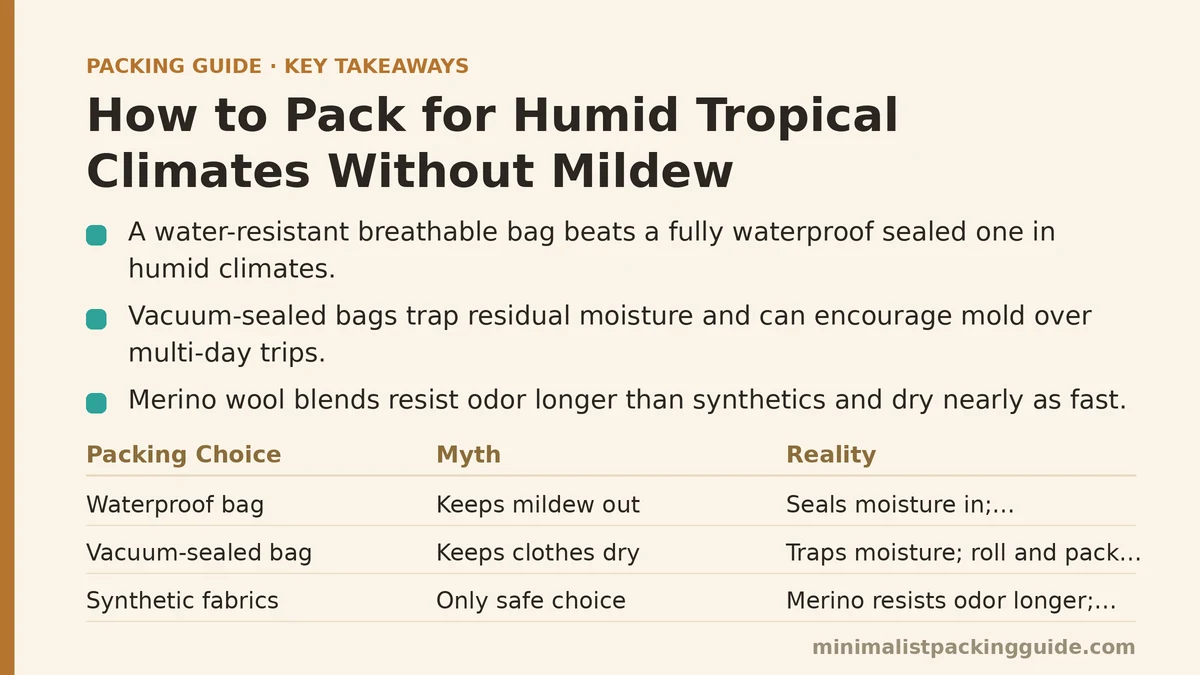
Myth: A Waterproof Bag Solves the Humidity Problem
The instinct to buy a fully waterproof duffel or roll-top bag for tropical travel makes sense in the abstract. If rain can’t reach your clothes, the reasoning goes, mildew can’t form. In practice, a waterproof bag seals moisture in as effectively as it seals it out. Any sweat, any dampness from a swimsuit that wasn’t fully dry, any residual humidity from the air itself has nowhere to escape once the bag is closed.
Reality: A water-resistant or water-repellent bag with breathable fabric performs better than a fully sealed one in humid climates. The goal is not to keep water out entirely but to let moisture inside move outward. A roll-top that you can open fully each evening, plus a bag made of a quick-drying nylon or polyester shell, gives you a better climate inside your luggage than a welded PVC sack ever will.
Myth: You Need Vacuum-Sealed Bags to Keep Clothes Dry
Vacuum-sealed compression bags have become a default recommendation for tropical travel, often presented as a defense against both space and moisture. They do compress clothing well. They also trap any residual moisture in the fabric at the moment of sealing, creating a sealed greenhouse that actively encourages mold growth over a multi-day trip.
Reality: Compression without airtightness is the right approach. Roll your clothes tightly using the bundle-wrap method, which expels air through the act of rolling itself, and pack them loosely enough that the bag can breathe. The minimal space savings you gain from vacuum-sealing is not worth the moisture risk. A tightly rolled bundle already reduces volume by nearly the same amount without depriving the fabric of airflow.
Myth: Synthetic Fabrics Are the Only Safe Choice for Tropical Travel
Synthetic quick-dry fabrics dominate tropical packing lists, and they do dry faster than cotton. But a polyester t-shirt that dries quickly also clings to body odor faster, holds onto that odor through multiple wears, and — in high humidity — can still feel damp hours after washing if the air is already saturated. The trade-off is less straightforward than most packing guides suggest.
Reality: Merino wool blends perform better in humid tropics than most travelers expect. They resist odor far longer than synthetics, which reduces how often you need to wash, which reduces how much damp clothing you carry. They also dry nearly as fast as polyester when rolled in a towel first. A rotation of merino t-shirts and lightweight merino socks, combined with a couple of quick-dry synthetics for the highest-heat days, covers the full range without forcing you into all-synthetic clothing that holds odor like a sponge.
Myth: You Must Wash Clothing Every Day in the Tropics
The assumption that a hot, humid climate demands a fresh shirt every few hours drives most tropical overpacking. Travelers double or triple their clothing quantities to compensate for perceived sweat levels, then end the trip with a bag full of semi-worn, slightly damp garments that have been sitting in warm, still air for days.
Reality: Rotation beats quantity. Three to five shirts, each worn on a rotating pattern with a day of rest between wears, allows sweat to fully dry and odor to dissipate before the next rotation. A light hand-wash in a sink with a drop of soap, followed by a towel-roll press, restores a shirt in under an hour of drying time in most tropical air. The ten-shirt packing list only ensures you bring ten damp shirts home instead of five.
Myth: Desiccant Pouches and Moisture Absorbers Prevent Mildew in Your Bag
Silica gel pouches and moisture-absorbing sachets are a popular add-on for tropical travelers, marketed as a low-cost insurance policy against dampness. They do absorb a small amount of moisture. They cannot absorb the volume of humidity that accumulates inside a sealed bag over the course of a day in the tropics — the math doesn’t work in your favor.
Reality: The most effective moisture control in your bag is not an absorbent pouch but a single sheet of breathable fabric. A lightweight cotton or linen drawstring bag, placed loosely over your folded clothing, allows moisture to migrate outward overnight when you open your main bag in the hotel room. Airflow is the desiccant. If you do want a pouch, hang it in the hotel closet before the trip, not inside your luggage.
Myth: You Need a Separate “Damp Pack” for Wet Items
Many packing guides for tropical travel recommend a dedicated waterproof sack for swimwear, wet shoes, and damp towels. That advice creates a second bag that stays sealed and damp for the entire trip. When you open it three days in, the contents smell like a well-established mildew colony.
Reality: A mesh or ventilated wet bag with a drainage hole at the bottom outperforms a sealed waterproof one. Pack wet items flat against the outside edge of your main bag, where the fabric can breathe and moisture can evaporate through the bag’s side. If you must use a sealed pouch for wet gear, place it inside the bag only when the items are nearly dry — and air the pouch itself overnight each evening.
A Practical Humidity-Safe Packing Sequence
Roll all clothing using the bundle-wrap technique, keeping merino and synthetic pieces in a mixed rotation rather than in separate zones of the bag. Place the bundle at the center, cushioned by rolled casual items on all sides. Pack a single mesh wet bag flat against one wall, containing only fully wrung-out swimwear — never a damp towel. Fold a lightweight linen drawstring bag flat on top of the bundle as a final layer. Leave the bag unzipped by a couple of inches each night in the hotel, and hang any damp items on available hangers or the shower rail. That five-step sequence consistently keeps clothing fresh for a week or more.
Quick Reference: Humidity Myth vs. Reality
| Myth | Reality |
|---|---|
| Waterproof bags prevent mildew | Breathable bags let trapped moisture escape |
| Vacuum-sealed compression keeps clothes dry | Tight rolling expels air without sealing in moisture |
| Synthetics are the only safe tropical fabric | Merino blends dry fast, resist odor, and breathe better |
| You need a fresh outfit daily in the tropics | A rotating 3-to-5 piece wardrobe keeps you dry with fewer items |
| Desiccant pouches stop mildew | Airflow overnight is the only desiccant that scales |
| Sealed wet bags protect your main luggage | Mesh or ventilated wet bags let moisture evaporate |
If you’ve had a run-in with mildew on a past tropical trip — or if you have a specific destination and itinerary in mind — tell me the details and I can map out a rotation and packing list for your exact climate and duration.
Related guides: How to Pack One Bag for a Trip Across Both Cold and Hot Climates, How to Pack a Rain Jacket and Stay Dry Without Adding Bulk, and How to Pack for a Surfing Trip Without Checking a Board Bag.