Cold-weather minimalist packing is the practice of fitting everything needed for a 2–5 day city break in temperatures roughly between −5 °C and 10 °C (23–50 °F) into a single carry-on, by treating warmth as a function of layering rather than of garment count. The number that matters is not how many warm items you own but how many distinct temperature bands your layers can cover. A three-piece layering system — base, mid, shell — typically covers a 20–25 °C (36–45 °F) effective range, which is more than a winter city break will ask of it.
Most cold-weather overpacking comes from a small set of assumptions that sound prudent and cost real space. Below, each assumption is set against what the bag math shows.
Myth: Cold Weather Means a Bigger Bag
The instinct is linear: colder destination, bigger suitcase. In practice, cold-weather clothing is often less voluminous per unit of warmth than people assume, because the warmest items are the ones designed to compress — down jackets, merino base layers, and fleece mid-layers all pack smaller than the equivalent warmth in cotton sweaters or denim.
Reality: A 35–40 L carry-on comfortably holds a 3–5 day cold-weather city wardrobe for one person, provided the bulk is concentrated in one insulating layer and the rest of the bag stays thin. The single biggest space driver is not the cold itself but duplicate insulation — two sweaters, two jackets, or two pairs of jeans, each added “just in case.” One insulating layer plus one shell replaces the pile.
Myth: You Need a Different Outfit Every Day
Fear of visible repeat-wearing drives people to pack five of everything. On a city break, the outer layers are seen by nobody twice and the inner layers are the only thing that needs rotation.
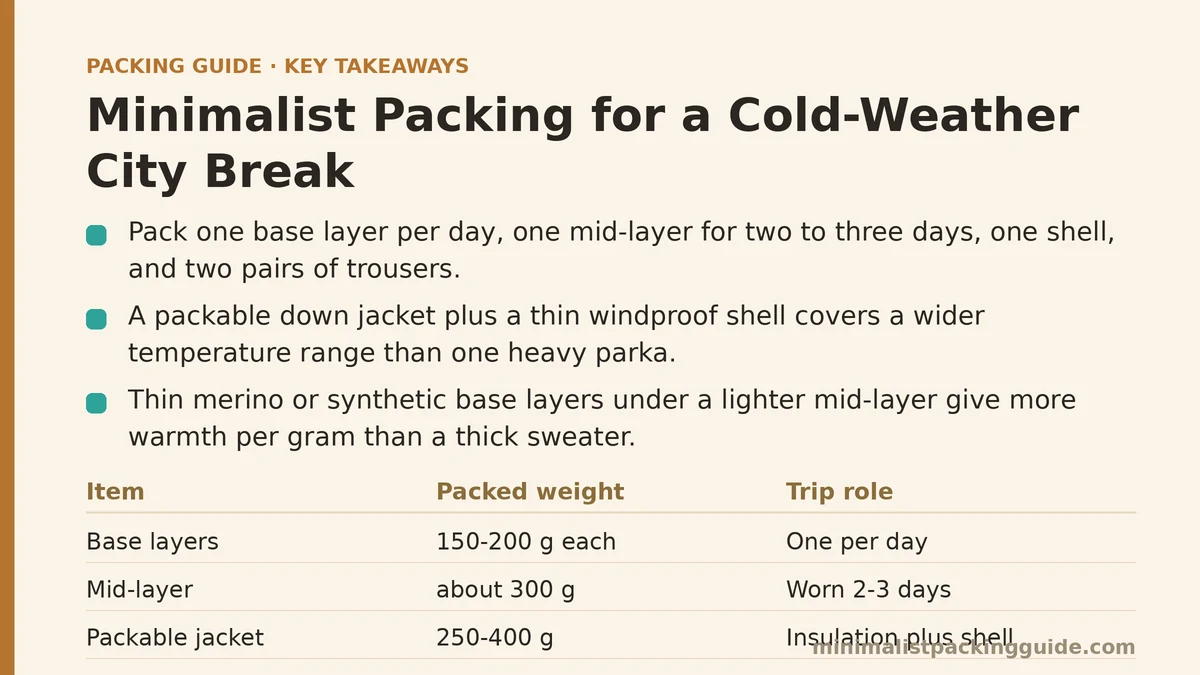
Reality: A workable formula is one base layer per day, one mid-layer worn two to three days, one shell for the whole trip, and two pairs of trousers. That is roughly 8–10 garments for a five-day trip, which fills about 60 percent of a 40 L bag once footwear is included. The remaining space covers toiletries, chargers, and a small day bag.
Myth: Thick Sweaters Are the Efficient Way to Stay Warm
Chunky knit sweaters feel like serious cold-weather gear, and they weigh 400–700 g each while occupying a third of a carry-on. They also trap moisture and dry slowly, which matters when you are washing one item in a hotel sink.
Reality: Thin merino or synthetic base layers worn under a lighter mid-layer provide more warmth per gram than a thick sweater, because the warmth comes from trapped air between layers rather than from fabric thickness alone. Two 150–200 g base layers plus one 300 g fleece or thin down mid-layer typically outperform a single heavy sweater at similar or lower packed volume.
Myth: One Big Coat Covers Everything
A single heavy parka is the classic cold-weather packing mistake in the other direction: it is warm, but it is rigid, does not pack into a bag, and commits you to one temperature band for the whole trip.
Reality: A packable down or synthetic jacket (typically 250–400 g, compressing to the size of a melon) plus a thin windproof/waterproof shell covers a wider range than one parka. Worn separately, they handle mild drizzle at 8 °C; worn together, they handle wind at −5 °C. The shell also doubles as rain protection, which a parka alone may not provide.
Myth: Boots Are the Only Sensible Footwear
Winter city breaks are usually walked, and the assumption is that boots are mandatory. Boots are heavy — 500–900 g per pair — and take up more bag space than any other item.
Reality: For most urban cold-weather trips, one pair of waterproof, insulated walking shoes or low boots worn on the plane, plus one pair of lightweight packable shoes or slippers for evenings, is sufficient. The key variable is the sole and the waterproof membrane, not the height of the shaft. If snow or slush is forecast, wear the boots and pack the lighter pair — never pack both pairs of heavy footwear.
Myth: Cold Means More Toiletries and More Gear
Cold weather does prompt extra items: lip balm, heavier moisturizer, gloves, a hat, a scarf. Each seems small, and together they add up to a full packing cube.
Reality: The cold-weather accessory set can be kept to four items totaling under 300 g: one hat, one pair of gloves, one scarf or neck gaiter, and one lip balm. Everything else is a duplicate. The same logic applies to electronics — cold drains batteries faster, so one power bank (typically 100–150 g) is worth more than a second charger.
Side-by-Side: Common Cold-Weather Packing Choices
| Item | Typical packed weight | Space cost in a 40 L bag | Verdict |
|---|---|---|---|
| Heavy knit sweater | 400–700 g | High (bulky, slow-drying) | Replace with base layer + thin mid-layer |
| Packable down jacket | 250–400 g | Low (compresses small) | Keep — core insulation |
| Thin windproof shell | 150–300 g | Low | Keep — wind and rain layer |
| Winter parka | 900–1,500 g | Very high (often unpackable) | Wear only if forecast demands it |
| Insulated waterproof boots | 500–900 g per pair | High | Wear on plane, do not pack |
| Lightweight packable shoes | 200–300 g per pair | Low | Pack as second pair |
| Merino base layer (×3) | 150–200 g each | Low | Keep — daily rotation |
| Two pairs of jeans | 500–700 g each | High | Reduce to one trouser + one spare |
If X, Then Y: Quick Decision Branches
- If the forecast low is above 5 °C (41 °F): skip the down jacket and bring a fleece plus shell. You will save roughly 300 g and a third of a packing cube.
- If the forecast low is below −5 °C (23 °F): add one thin thermal base layer, not a heavier coat. Layering handles extreme cold better than a single heavy garment.
- If rain is likely on two or more days: prioritize the waterproof shell over the warmer mid-layer. Wet and cold is worse than dry and cool.
- If you plan to eat out in the evenings: pack one pair of presentable shoes and one collared shirt or equivalent. This adds under 400 g and prevents the “nothing to wear to dinner” problem.
- If your airline weighs carry-ons at the gate: move dense items (shoes, chargers, toiletries) to your personal item. Cold-weather bags commonly run 8–10 kg packed, which exceeds the 7 kg limit on some budget carriers.
Common Mistakes and How to Recover
Overpacking insulation. If your bag will not close, remove the second sweater, not the base layers. Base layers are the cheapest warmth per gram.
Forgetting the drying problem. Cold-weather trips mean damp gloves, damp socks, and damp base layers. Pack one small quick-dry towel and plan to wash base layers in the sink every second night rather than bringing five of them.
Ignoring the airport-to-city temperature gap. You will be indoors at 20–22 °C for parts of the day. A layering system that cannot be stripped down to a base layer and trousers will leave you overheated in museums and restaurants. Test the system by asking: can I remove two layers and still look presentable?
Packing boots and wearing sneakers. Reverse this. Wear the heaviest, bulkiest footwear on the plane and pack the light pair.
What to Do Next
- Check the forecast low for your destination, not the high. Pack to the low; the high will take care of itself through layering.
- Build a three-layer system: one base layer per day, one mid-layer, one shell. Lay all three out and confirm they combine into something you would wear at the coldest expected temperature.
- Weigh the packed bag. A cold-weather carry-on commonly lands at 8–10 kg. If your airline has a 7 kg limit, move dense items to your personal item before you leave home.
- Pack one accessory set only — hat, gloves, scarf, lip balm — and leave the duplicates behind.
A cold-weather city break does not require a bigger bag. It requires fewer, better-chosen layers and a willingness to wear the same shell two days running.
Related guides: How to Pack for a Wedding in a Carry-On Only, Carry-On Packing Mistakes That Trigger Airline Gate Checks, and Minimalist Packing Mistakes Carry-On Only Travelers Make.