A business-leisure hybrid trip is any itinerary where one booking contains at least one work obligation and at least one non-work segment — a conference plus a weekend, client meetings plus a few days of sightseeing, a remote-work stretch bracketed by travel. The packing problem this creates is not that the two categories are incompatible. It is that each category carries its own space budget, its own formality floor, and its own weather assumptions, and most packing mistakes on hybrid trips come from letting one category silently consume the other’s resources.
The following ranked list orders the mistakes by how much damage they typically cause — measured in liters of bag volume lost, kilograms added at the gate, or items you end up buying on the road because you left them out. Each entry includes what the mistake costs and how to correct it.
1. Packing two separate wardrobes instead of one overlapping one
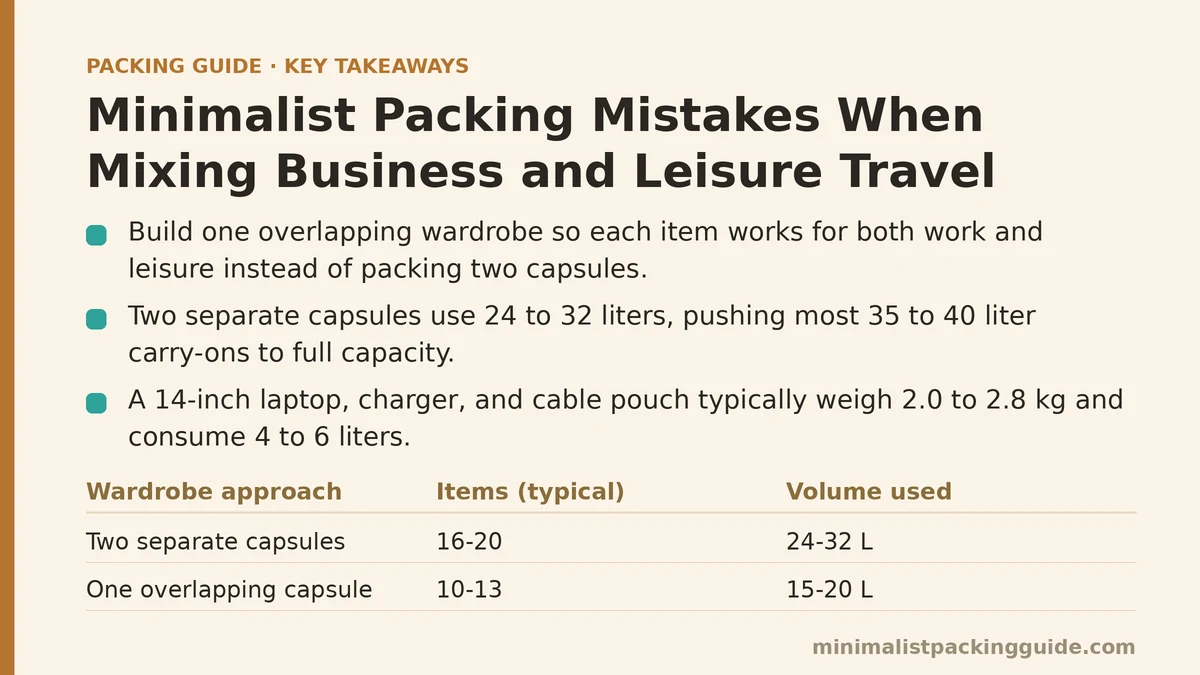
This is the single most common failure and the one that breaks the carry-on budget outright. The instinct is to build a “work capsule” and a “leisure capsule” as though they were two trips sharing a suitcase. A typical work capsule — two dress shirts, dress trousers, a blazer, dress shoes, a belt, a tie — occupies roughly 14 to 18 liters once folded. A typical leisure capsule — two t-shirts, shorts, a swimsuit, walking shoes, a light layer — adds another 10 to 14 liters. Combined, that is 24 to 32 liters before toiletries, laptop, or chargers, which pushes most standard 35 to 40 liter carry-ons to 100 percent capacity or beyond.
The correction: build one wardrobe where every item does double duty. A pair of dark, straight-leg trousers works for a client meeting and for a dinner out. A plain merino crewneck serves as a smart layer over a dress shirt and as a casual layer on a day off. One pair of leather sneakers can clear a business-casual dress code and comfortably cover 15,000 walking steps. The goal is not fewer clothes than two capsules — it is fewer categories.
| Wardrobe approach | Items (typical) | Volume used | Leaves room for laptop + toiletry kit? |
|---|---|---|---|
| Two separate capsules | 16–20 | 24–32 L | Usually no |
| One overlapping capsule | 10–13 | 15–20 L | Yes, with margin |
2. Treating the laptop and its accessories as a fixed cost
Hybrid travelers tend to accept the laptop, charger, mouse, cable pouch, and external battery as non-negotiable, then pack clothing around them. That is backwards. A 14-inch laptop, charger, and cable pouch typically weigh 2.0 to 2.8 kg and consume 4 to 6 liters. Those numbers are only fixed if you refuse to consider alternatives.
Where the slack usually is:
- Charger. A single 65 W gallium-nitride charger replaces a laptop brick and a phone brick. Typical weight saving is 150 to 300 g and one full outlet slot.
- Cable pouch. Trim to one charging cable per device plus one backup. Multi-cable pouches commonly carry 4 to 6 cables when 2 will cover the trip.
- Battery. If the flight is under 4 hours and you have a charger at the destination, the power bank is often dead weight. Check whether the airline requires it in the cabin anyway — many do, and it must then live in your personal item rather than the carry-on.
The leverage here is that electronics sit at the dense end of the bag. Every 500 g you remove from this category is roughly 500 g you can spend on the leisure segment.
3. Letting the leisure segment set the shoe count
Business segments have a low tolerance for shoe variety — one pair of presentable shoes covers nearly every meeting. Leisure segments have a high tolerance, and that is where shoe count quietly explodes. Three pairs of shoes typically weigh 1.8 to 3.0 kg and consume 8 to 12 liters, which is often a third of a carry-on on its own.
Decision rule: on a hybrid trip of 7 days or fewer, cap shoes at two pairs total.
- Pair one: the one that must satisfy the most formal moment on the itinerary. If there is one client meeting, this is dress shoes or a polished leather sneaker.
- Pair two: the one that must survive the most physical activity. Walking shoes, trail runners, or sandals depending on the leisure segment.
Wear the heavier pair onto the plane. If the leisure segment includes a beach or pool, sandals weigh 200 to 400 g and pack flat against the bag wall, which makes a third pair defensible only in that specific case.
4. Assuming the weather is the same for both segments
A three-day conference in a climate-controlled venue plus a two-day hiking detour in the same city can require a temperature range spanning 15°C. Packing for only the business segment is the more common error, because the business segment is usually the one with a fixed dress code and the one travelers plan first.
Before/after comparison for a typical autumn hybrid trip (business 18–22°C indoors, leisure 6–14°C outdoors):
| Item | Packing for business only | Packing for both segments |
|---|---|---|
| Outer layer | Blazer only | Blazer + packable insulated jacket (250–400 g) |
| Base layer | Dress shirts | Dress shirts + one merino base layer |
| Footwear | Dress shoes | Dress shoes + walking shoes |
| Total added weight | — | 0.8–1.3 kg |
The packable insulated layer is the highest-value single addition on a hybrid trip. It compresses to the size of a grapefruit, weighs under 400 g in most cases, and converts the same base outfit from indoor-appropriate to outdoor-viable.
5. Over-packing formal accessories for a single event
One wedding, one awards dinner, or one keynote is enough to trigger a full accessory duplication: two ties, cufflinks, a second belt, a dress watch, a shoe bag. Each item is small, which makes each item easy to justify, and the total is typically 0.6 to 1.1 kg and 2 to 4 liters of scattered volume.
The correction: pick the accessories for the single most formal moment and stop there. One belt that matches both the dress shoes and the walking shoes (dark brown or black leather covers the widest range). One tie if the outfit requires one. Cufflinks only if the shirt has French cuffs. A dress watch is redundant if a single everyday watch is presentable.
6. Packing laundry as an afterthought
Hybrid trips are usually longer than pure business or pure leisure trips of the same bag volume, because they combine two purposes. A 4-day business trip and a 4-day leisure trip can each run on 4 days of clothing. A 4+4 hybrid packed as 8 days of clothing will not fit. The standard resolution is to do laundry once mid-trip, which requires either access to a machine or a sink-wash setup.
What that requires you to pack:
- A 30 to 50 ml bottle of concentrated detergent (or a few laundry sheets)
- A travel clothesline if the accommodation lacks a drying rack (40 to 90 g)
- Two or three quick-dry items so one wash cycle covers two days of wear
Missing any of these turns a planned mid-trip wash into a laundromat detour that can cost 90 minutes and 10 to 20 dollars.
7. Packing the personal item as an overflow bag instead of a deliberate one
One-bag travelers often treat the personal item as whatever fits under the seat and gets filled last. On a hybrid trip this is expensive, because the personal item is the escape valve if a gate check happens, and it is where in-flight essentials need to live.
Checklist for the personal item on a hybrid trip:
- Laptop and charger (so work can continue in flight or at a delay)
- All travel documents, ID, and boarding pass
- Medication and any spare lithium batteries
- One change of underlayer if the flight is over 6 hours
- Nothing that belongs exclusively to either segment — this bag is shared between both
If the personal item is stuffed with leisure-only items, a gate check leaves you separated from your work tools. If it is stuffed with business-only items, a delayed flight leaves you without a change of clothes.
8. Failing to define the handoff point between segments
The most subtle mistake on the list, and the one most likely to send you to a shop mid-trip. On a hybrid itinerary, the business and leisure segments often begin in different places — a conference hotel, then a train to a smaller town, or a client office, then a rental car to a national park. Different segments may also mean different dress codes, different amenities, and different packing needs.
Before you leave, write down three things:
- The date and location of the transition between the business and leisure segments.
- What changes at that transition — which items get retired (dress shoes you will not need again), which get activated (swimwear, hiking layers), and whether you will have access to a washer.
- Whether the bag configuration changes. If you are checking a bag for the business segment but going carry-on-only for the leisure segment, that decision has to be made before departure, not at the airport.
The common failure is arriving at the leisure segment and discovering that a specific item was only packed because it belonged to the business segment — and now has to be carried, stored, or shipped for the second half of the trip.
What to do before your next hybrid trip
Work through these five steps in order, ideally the week before departure:
- Lay out the itinerary and mark the formal moments and the physical moments. A formal moment is any event with a dress code. A physical moment is any activity involving sustained walking, weather exposure, or terrain.
- Build the wardrobe from the overlap, not from the segments. Start with the items that satisfy both, then add the minimum necessary to cover the edges.
- Cap shoes at two pairs unless a beach or pool element justifies a third.
- Plan the laundry — book accommodation with a machine, or pack detergent and a line.
- Pack the personal item as though it will be your only bag for at least 12 hours, and confirm that the laptop and travel documents are inside it.
Hybrid trips break down at the seams, not in the middle. Protect the seams — the handoff between business and leisure, the escape valve of the personal item, and the overlap between the two wardrobes — and the rest of the bag tends to hold.
Related guides: Carry-On Packing Guide for Finance Professionals on Business Trips, How to Pack for a Wedding in a Carry-On Only, and Packing Mistakes One-Bag Travelers Make and How to Fix Them.