Say you are trying to fit a two-day client meeting, a Thursday-to-Friday roadshow, and a possible dinner into a single carry-on, and your calendar already shows a 6 a.m. flight with a connection. The suit has to arrive pressed, the shoes have to survive the overhead bin, and the laptop, charger, and deal documents have to stay on your person in case the bag gets gate-checked. Finance travel compresses the margin for error because the dress code is unforgiving and the schedule rarely leaves time to shop, iron, or improvise.
Most of the packing advice aimed at business travelers assumes you have a checked bag or a hotel with same-day pressing. Neither is reliable on a two-day trip. What follows is a myth-by-myth breakdown of the assumptions that push finance travelers toward a roller bag and a garment bag, plus what the practical alternative looks like in a single carry-on.
Myth: A Suit Needs a Garment Bag to Arrive Presentable
The garment bag is the reflex tool for anyone packing a suit, and it is the first thing to leave behind. A hanging garment bag either counts as a second carry-on item — which most major carriers no longer allow alongside a full-size roller — or it gets folded into the main compartment anyway, at which point you are carrying the fabric of a second bag for no benefit.
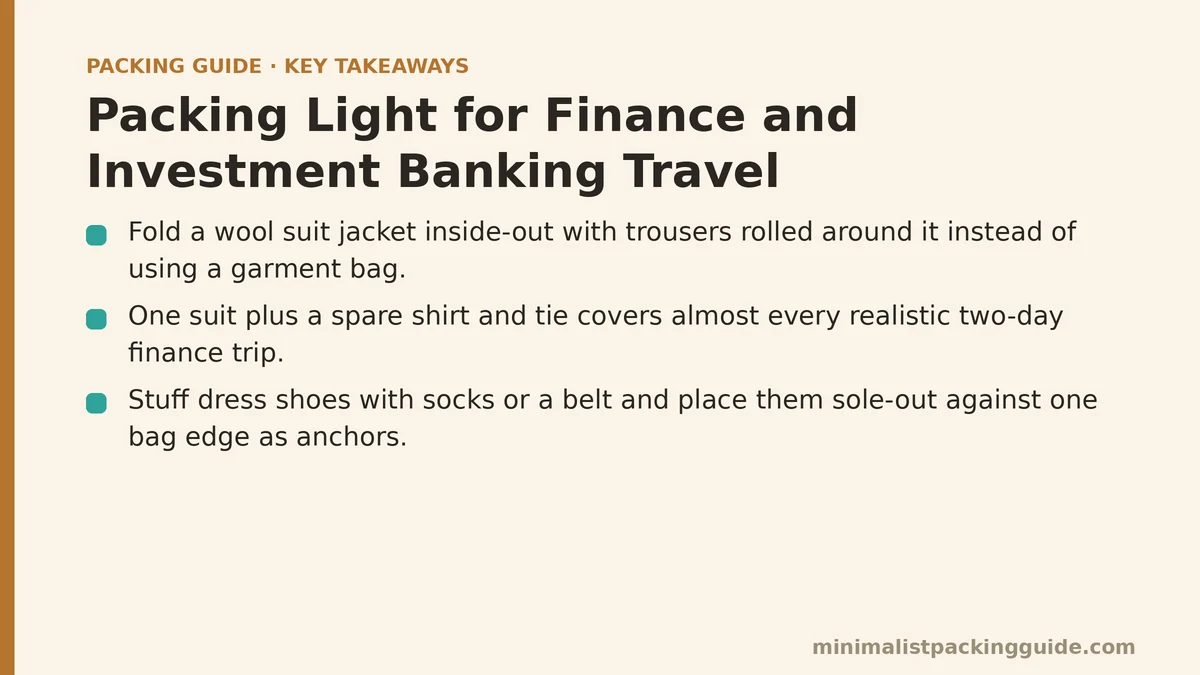
Reality: A wool suit folded with the jacket inside-out and the trousers rolled around it travels with fewer creases than most people expect, and it does so inside the same compartment you were already using. The folding technique matters more than the container. Lightweight wool and wool-blend suits recover from fold creases within an hour or two of hanging, especially in a hotel bathroom with the shower running for ten minutes. Structured suits with heavy canvas and fused fronts crease more stubbornly, which is a fabric choice to factor in when buying, not a packing failure to solve with extra luggage.
Myth: You Need a Second Suit for a Two-Day Trip
Fear of a stain, a spill, or a bad dinner drives many finance travelers to pack two full suits for a trip that only requires one formal day. That decision roughly doubles the single most space-consuming category in the bag.
Reality: One suit plus a spare shirt and a spare tie covers almost every realistic two-day scenario. If the schedule includes two formal days, wear the same suit with a different shirt and tie rather than packing a second one. If a spill happens, a stain pen and a hotel sink handle it. The genuine risk on short finance trips is not outfit failure — it is arriving with a bag too full to close, or too heavy to lift into the overhead bin without help.
Myth: Formal Shoes Need Heavy Padding and Their Own Compartment
Dress shoes get treated as fragile cargo more than any other item on a business packing list. Travelers wrap them in cloth, dedicate a compartment, and worry about them crushing a laptop or a folded shirt.
Reality: Leather dress shoes are dense and shape-stable. They hold their form better than almost anything else in the bag. Stuff each shoe with rolled socks or a belt to keep the toe box from collapsing, then place them sole-out against one edge of the bag where they anchor that corner. That corner is also the best place to pack anything crush-sensitive — put the laptop sleeve or a folded shirt on the inside face of the shoe rather than the outside.
If the trip runs three days or more and includes both a formal event and a travel day, a second pair of lighter shoes (a dark sneaker or a loafer) is a reasonable addition. Two pairs is the practical ceiling for a carry-on; three pairs rarely earns the space.
Myth: The Laptop and Documents Can Ride in the Overhead Bag
This is the myth with the highest cost when it fails. Gate checks are common on full flights, and a gate-checked carry-on goes into the cargo hold at the boarding door. Everything inside it — laptop, charging cables, deal documents, medication — becomes inaccessible for the duration of the flight and can arrive on a different carousel or, in rare cases, not arrive at all.
Reality: The laptop, chargers, passport, and any hard-copy documents belong in the personal item that stays under the seat in front of you. That personal item should be one bag, sized to fit under the seat, and it should carry everything you cannot afford to lose access to. If your main carry-on is gate-checked, you should be able to walk onto the plane with the personal item and lose nothing you need for the meeting.
A practical split for finance travel:
| Item | Main carry-on | Personal item (under seat) |
|---|---|---|
| Suit, shirts, ties | Yes | No |
| Dress shoes, belt, socks | Yes | No |
| Laptop, charger, adapter | No | Yes |
| Deal documents, printed materials | No | Yes |
| Passport, ID, boarding pass | No | Yes |
| Medication, power bank (spare batteries) | No | Yes |
| Toiletry pouch (under 100 ml liquids) | Yes | Optional |
| Change of underwear and socks | Yes | No |
Spare lithium batteries and power banks are prohibited in checked baggage in most jurisdictions, which makes the personal item the only legal place for them on a gate-checked flight. Packing them into the carry-on means pulling them out at the boarding door while the line moves behind you.
Myth: One-Bag Travel Means Wearing the Same Shirt Three Days
Finance travelers often assume minimalist packing means visible repetition — the same shirt on day one and day two, which is a non-starter in a client-facing role. That assumption pushes people toward packing four shirts for a two-day trip.
Reality: One suit, two dress shirts, and one or two ties covers a two-day client trip with a dinner. A third shirt is worth the space only if a travel day threatens a spill or if the trip extends past three nights. These are the items that compress best: a dress shirt folded and rolled takes roughly the space of a paperback novel, and two of them fit in the gaps around a folded suit without expanding the bag’s outer dimensions.
Wool and wool-blend shirts resist odor and creasing better than cotton over a multi-day trip. If your rotation is cotton, pack one extra and plan to hand-wash in the hotel sink.
Myth: Business Travel Requires a Checked Bag Because of Liquids and Grooming
The liquids rule is frequently cited as the reason finance travelers check a bag. The assumption is that a full grooming kit — cologne, shaving cream, moisturizer, hair product — cannot fit into the 100 ml / 1 quart bag limit.
Reality: Most grooming items are available in travel sizes or solid forms. A shaving soap bar, a solid cologne, and a 90 ml moisturizer together fit comfortably in a quart bag alongside a 50 ml toothpaste and a 90 ml deodorant. Anything larger can be decanted into a 100 ml bottle or left at home and bought at the destination. The liquids bag is a constraint, not a barrier to carry-on travel.
Myth: Rolling and Bundling Are Optional If You Fold Carefully
Careful folding is not the same as compression. A neatly folded shirt still occupies its full volume. The compressing techniques that make one-bag finance travel work — bundle wrapping and the ranger roll — are what produce the space savings, not precision folding.
Reality: The bundle-wrap method places the suit jacket at the core and wraps shirts, trousers, and soft items around it, so the jacket is protected from the bag’s edges and the whole bundle compresses under the bag’s straps. Rolled items fill the gaps. The difference between a neatly folded bag and a bundled one is commonly 20 to 30 percent of the usable volume — enough to make the difference between a bag that closes flat and one that bulges at the sizer.
A flat profile matters as much as total volume. A bag that bulges in the middle fails the airline sizer even if its total contents would fit if redistributed. Pack structured items (shoes, laptop sleeve, toiletry pouch) against the back panel and soft items toward the opening.
Myth: A Three-Day Trip Justifies a Larger Bag
A three-day trip is the threshold where many finance travelers switch from a carry-on to a checked roller. The math rarely supports it. Three days of formal clothing plus one casual change fits in a standard 22 x 14 x 9 inch carry-on when bundled, provided the shoe count stays at two pairs or fewer.
Reality: The breakpoint is not trip length in days — it is laundry access and shoe count. A trip of four to five days with hotel laundry access packs into the same carry-on. A trip with three formal events and three shoe changes does not, regardless of length. Decide on the bag by counting shoes and formal outfits, not by counting nights.
If weight limits are the concern, note that many full-service carriers cap carry-ons at 7 to 10 kg, and some budget and Asian carriers enforce 7 kg at the gate. A fully packed one-bag formal setup commonly lands between 8 and 11 kg, which means dense items — shoes, chargers, the toiletry pouch — may need to shift to the personal item or to jacket pockets before boarding a strict carrier. Weigh the packed bag at home; a luggage scale costs under $15 and prevents a gate fee that commonly runs $50 to $75.
Myth: Wrinkles Are Unavoidable Without Hotel Pressing
The final myth is that a folded suit will arrive looking like it was slept in, making hotel pressing a mandatory line item. Pressing is useful, but it is not the only solution.
Reality: Hanging the suit in the bathroom with the shower running hot for ten minutes relaxes most fold creases in lightweight wool. A travel steamer — many are under 400 g and fit inside a shoe — handles the rest. Packing the jacket inside-out, with the lining facing out, protects the exterior fabric from abrasion during transit and reduces the sharpest creases along the lapel and shoulder.
These are the recovery steps if the suit arrives creased and pressing is unavailable:
- Hang the suit in the bathroom and run the shower hot for 10 minutes with the door closed.
- Smooth the lapels and shoulders by hand while the fabric is warm and slightly damp.
- Let it hang overnight; most lightweight wool recovers by morning.
- Reserve hotel pressing for structured suits and for the rare trip where the first meeting is the same morning as arrival.
Myth vs. Reality: Quick Reference
| Myth | Reality |
|---|---|
| A suit needs a garment bag | A bundled suit travels inside the carry-on with fewer creases than expected |
| Two days means two suits | One suit, two shirts, and one or two ties covers a two-day client trip |
| Dress shoes need padding and a separate compartment | Dense, shape-stable shoes just need stuffing and an anchor position |
| Laptop and documents can ride in the overhead bag | They belong in the personal item that stays under the seat |
| One-bag travel means visible shirt repetition | Two shirts for two days is standard; a third is optional |
| Liquids rules force a checked bag | Travel sizes and solid grooming products fit the 1 quart bag |
| Careful folding is enough | Bundle wrapping and rolling produce the 20–30 percent volume savings |
| Three days justifies a checked bag | Breakpoint is shoe count and laundry access, not nights |
| Wrinkles require hotel pressing | Shower steam and a travel steamer recover most lightweight wool |
What to Do Before Your Next Finance Trip
Three steps you can take today:
- Audit your last trip’s bag by category. List what you packed and what you wore. Most finance travelers find one unused formal outfit, one unused pair of shoes, and a grooming kit that never left the pouch. Remove those categories from the next packing list and see whether the bag still closes flat.
- Test the bundle fold at home. Fold your suit inside-out, wrap the trousers, and place it in the bag with your usual shirts around it. Measure the bag’s outer dimensions, wheels included, against your airline’s stated limit. If it bulges, remove one shirt or move the toiletry pouch to the personal item.
- Separate the personal item into a fixed kit. Laptop, charger, adapters, documents, passport, medication, and spare batteries go in one small bag that stays under the seat. Run the packed main carry-on through a mental gate-check: if it went into the hold at the boarding door, would you still have everything you need for the first meeting? If the answer is yes, you have packed for finance travel correctly.