Say you are trying to fit a week of skiing into a single carry-on, and you’ve already made peace with checking or renting the skis, board, and boots at the resort. What’s left is everything else — jacket, pants, layers, gloves, goggles, the whole supporting cast — and that pile is exactly what decides whether the bag zips shut without a fight.
Not every item in that pile weighs on your space budget equally. Some categories eat a third of your bag by themselves. Others barely register. Ranking them by how much room they actually consume, rather than packing in whatever order comes to mind, is the fastest way to see where your effort should go.
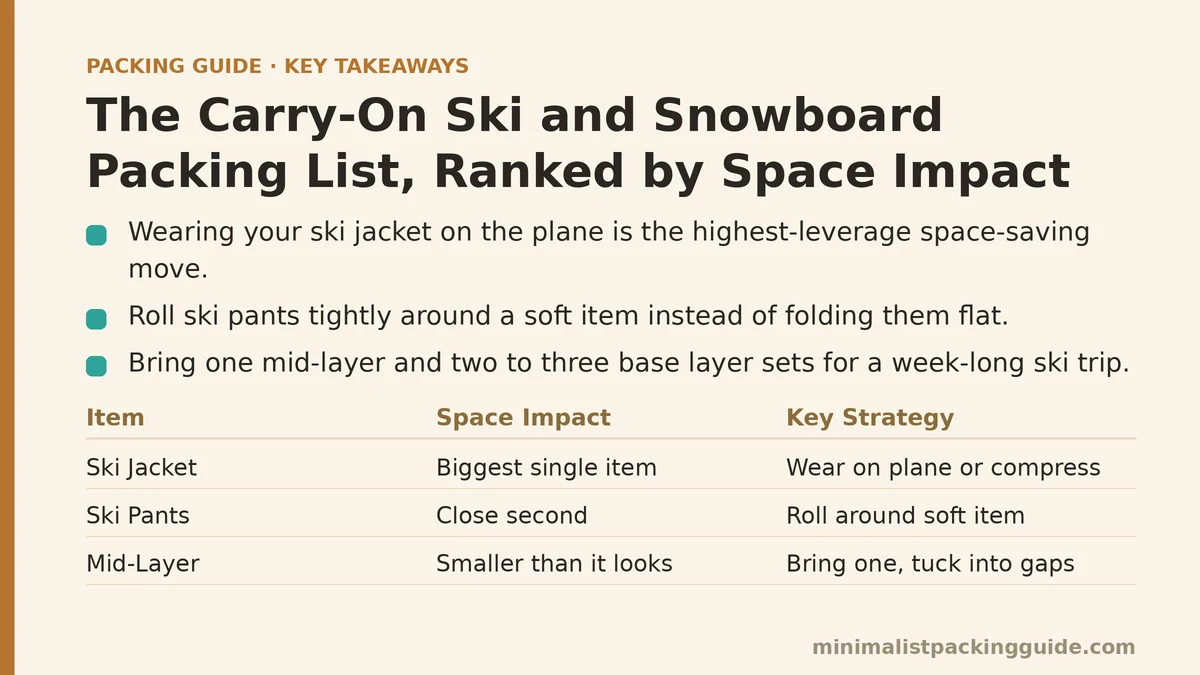
1. The Ski Jacket — The Biggest Single Space Consumer
A shell or insulated ski jacket is the single largest item most people bring on a winter trip, full stop. Even a well-made three-layer shell holds its shape stubbornly, resists folding flat, and tends to trap air pockets that inflate its packed volume well beyond what the fabric alone would suggest.
Compression is where you claw this back. Rolled tightly rather than folded flat, a ski jacket loses a surprising amount of that trapped air, and a compression cube or a firm roll-and-strap technique shrinks it further still. Wearing the jacket on the plane instead of packing it removes the problem entirely, and given how bulky ski jackets run compared to almost anything else on this list, wearing it is usually the single highest-leverage decision you can make for this trip.
2. Ski or Snowboard Pants — A Close Second
Insulated ski pants rank right behind the jacket, and for similar reasons: stiff synthetic insulation, reinforced knees and seat panels, and a cut that doesn’t fold down small no matter how you approach it. Where they differ from the jacket is that wearing them through security is less practical — most people aren’t comfortable sitting through a flight in full ski pants.
Rolling them tightly around a soft item like a fleece, rather than folding them flat on their own, uses the pants themselves as a wrapper and reduces wasted internal air space. If your pants have a bib or suspender-style top, that extra fabric is worth flattening deliberately before rolling — it’s the part most people leave puffed out and accidentally add an inch of unnecessary bulk to.
3. The Mid-Layer — Smaller Than It Looks, Bigger Than It Should Be
A fleece or insulated mid-layer sits well behind the jacket and pants in raw volume, but it’s the item most people overpack within its own category. One solid mid-layer, worn or swapped as conditions demand, covers most ski trips. Bringing two or three “just in case” is where this category quietly balloons past where it belongs.
A single synthetic-insulated or fleece mid-layer, rolled and tucked into the gaps left by the jacket and pants rather than given its own dedicated section of the bag, does the job. Anything beyond one mid-layer for a trip under a week is solving a problem that doesn’t exist yet.
4. Base Layers — Volume Scales With Trip Length, Not With Difficulty
Base layers rank lower on the space scale per item, but they’re the category most prone to multiplying. A week-long trip doesn’t need seven base layer sets; it needs two or three, worn in rotation and given a chance to air out between days, since base layers dry fast and ski resort accommodations almost always have some form of laundry access or at least a place to hang damp gear overnight.
Two top-and-bottom base layer sets covers the overwhelming majority of trips, with a third as backup for longer stays or colder-than-expected forecasts. Rolled tightly, these compress down to a fraction of the space a mid-layer takes, which is exactly why overpacking them causes less visible damage than overpacking a jacket — but it still adds up.
5. Accessories — Small Individually, Real Once You Add Them Up
Gloves, goggles, a neck gaiter, ski socks, hand warmers, a beanie — none of these takes much space on its own, and that’s exactly the trap. Packed loose, this category scatters across the bag, fills small gaps inefficiently, and becomes harder to find than its actual volume would justify.
The fix here isn’t compression so much as consolidation. A single small pouch or packing cube for all cold-weather accessories keeps this category contained to one predictable footprint rather than letting it bleed into every corner of the bag. Goggles are the one exception worth handling separately — they need a rigid or semi-rigid case to survive the trip without a cracked lens, and that case should go somewhere it won’t get crushed by the jacket or pants.
Where This Ranking Breaks Down: Boots and the Skis Themselves
Ski or snowboard boots and the skis or board are deliberately absent from this ranking, because for a true carry-on-only trip they usually aren’t going in the carry-on at all. Boots alone can rival the jacket in bulk and rarely compress at all, given their rigid shells. Renting boots and skis at the resort, or checking them as sports equipment, sidesteps this problem entirely rather than trying to solve it through folding technique — there’s no folding technique that shrinks a ski boot.
If you own boots that fit you well and renting isn’t appealing, treat them as a separate checked item on their own terms. Trying to force them into a carry-on packing strategy built around clothing is a mismatch from the start.
Quick Reference: The Ranking, Compared
| Rank | Item | Space Impact | Best Space-Saving Move |
|---|---|---|---|
| 1 | Ski jacket | Highest | Wear it on the plane instead of packing it |
| 2 | Ski pants | High | Roll tightly around a soft mid-layer |
| 3 | Mid-layer | Moderate | Limit to one, worn or swapped as needed |
| 4 | Base layers | Moderate, scales with trip length | Two or three sets, rotated and re-worn |
| 5 | Accessories | Low per item, adds up unconsolidated | One dedicated pouch, plus a rigid goggle case |
A Packing Order That Follows the Ranking
Start with the accessory pouch and goggle case at the bottom or along one side of the bag, since they’re small and won’t crush under anything reasonable. Roll the base layers next, using them to fill remaining gaps around that pouch. Roll the pants around the mid-layer as a single bundled unit, and place that bundle at the core of the bag where it’s protected from compression. Save the jacket for last — either worn onto the plane or, if it has to be packed, compressed and placed on top where it takes the least crushing pressure from everything underneath.
Related guides: A Step-by-Step Guide to Packing Your First Carry-On-Only Trip, Carry-On Packing Guide for Finance Professionals on Business Trips, and Minimalist Packing List for Pregnant Travelers.